
Sharing Your Faith

Lesson Information
This lesson helps learners understand the next faithful steps after responding to Christ. Using Matthew 28:19–20 as the foundation, the lesson explains that growing in faith is not a one-time decision but a daily walk with Jesus through Faith, Trusting God, Obedience, Perseverance, and Walking with Christ. Learners will be encouraged to move from simply knowing about faith to actively living as disciples who trust God, obey His Word, stay connected to the church, and help others follow Christ.
Content

Scripture Reading
- These notes are personal and are not shared.
- These notes are personal and are not shared.
- These notes are personal and are not shared.
- These notes are personal and are not shared.
- These notes are personal and are not shared.
- These notes are personal and are not shared.
Adult Passage 1
Study Topics
Choose a topic to search Scripture.
Biblical Theme Explorer
Browse the major themes, doctrines, people, places, events, and keywords connected through Harvest Bible studies.
Original Language Study
Open deeper study tools for the current chapter using BibleHub resources.
My Notes
Notes are saved in this browser for now.
Adult Explanation
Matthew concludes his Gospel with Jesus meeting His disciples after His resurrection. Having conquered sin and death, Jesus gives His followers a clear mission before ascending to the Father. These verses are commonly known as the Great Commission. Jesus commands His disciples to go, make disciples, baptize, and teach people to obey everything He commanded. This mission was not limited to the original disciples. It continues for every believer until Christ returns. Sharing the gospel is not an optional activity for a few gifted Christians; it is part of the calling of every follower of Jesus.
Focus on the Scripture
The main command of this passage is to make disciples of all nations. Believers should pay close attention to the fact that Jesus calls His people not only to share information about Him but to help others become faithful followers of Him. This passage matters because growing in faith includes helping others begin and continue their walk with Christ.
Adult Exegesis
Keyword Study
Disciple (Greek: *mathētēs*) — A learner, follower, or student. A disciple is someone who follows Jesus and seeks to live according to His teachings.
Go (Greek: *poreuomai*) — To go, travel, or move forward. The word emphasizes active participation in Christ's mission rather than passive observation.
The Great Commission is grounded in Jesus' authority. Just before giving this command, Jesus declares that all authority in heaven and on earth has been given to Him. Because Christ is King, His followers are called to obey His mission. Evangelism is not based on personal confidence but on Christ's authority and power.
Making disciples involves more than securing a decision. Jesus commands His followers to baptize believers and teach them to obey His instructions. The goal is transformed lives that increasingly reflect Christ. This reminds believers that evangelism and discipleship work together as part of God's plan.
The passage ends with a promise. Jesus assures His followers that He will be with them always. Sharing the gospel can feel intimidating, but believers do not carry out the mission alone. Christ's presence empowers and encourages His people as they faithfully proclaim the gospel message.
Adult Application
* Pray regularly for opportunities to share the gospel with unbelievers.
* View everyday relationships as opportunities for disciple-making conversations.
* Support your local church's evangelism and discipleship efforts.
* Trust Christ's authority and presence when fear or uncertainty arises.
* Invest time in helping new believers grow in their faith after conversion.
Adult Passage 2
Study Topics
Choose a topic to search Scripture.
Biblical Theme Explorer
Browse the major themes, doctrines, people, places, events, and keywords connected through Harvest Bible studies.
Original Language Study
Open deeper study tools for the current chapter using BibleHub resources.
My Notes
Notes are saved in this browser for now.
Adult Explanation
Before Jesus ascended into heaven, He gathered His disciples and prepared them for the mission ahead. The disciples were focused on questions about the future of Israel, but Jesus redirected their attention toward the task He was giving them. He promised that the Holy Spirit would empower them to be His witnesses. This verse serves as a summary of the book of Acts as the gospel spreads from Jerusalem to Judea, Samaria, and eventually throughout the world. It reminds believers that sharing faith depends on God's power rather than human ability.
Focus on the Scripture
The main promise of this passage is that believers receive power through the Holy Spirit to be witnesses for Christ. Christians should pay close attention to the source of their effectiveness. The mission of sharing faith is not accomplished through personality, education, or confidence alone. It is accomplished through the empowering work of the Holy Spirit.
Adult Exegesis
Keyword Study
Power (Greek: *dynamis*) — Strength, ability, or miraculous power. It refers to God's enabling power given through the Holy Spirit.
Witnesses (Greek: *martys*) — One who testifies or gives evidence concerning what they have seen or know to be true.
Jesus does not command believers to generate their own strength. Instead, He promises divine empowerment. The Holy Spirit equips believers with courage, wisdom, conviction, and opportunities to proclaim the gospel. This truth encourages Christians who feel inadequate or fearful about sharing their faith.
The role of a witness is not to invent a message but to testify to the truth. Believers share what God has done through Christ and how He has worked in their lives. A witness points people toward Jesus rather than drawing attention to themselves.
The geographical progression in this verse demonstrates God's heart for all people. The gospel was intended to spread beyond one city, culture, or nation. Every believer has a role in helping the message of Christ reach people both near and far. This includes personal evangelism, church outreach, missions, prayer, and support for gospel ministry.
Adult Application
* Depend on the Holy Spirit through prayer before sharing your faith.
* Be prepared to explain how Christ has changed your life.
* Look for opportunities to be a witness in your home, workplace, and community.
* Support missionaries and gospel outreach efforts beyond your local area.
* Trust God's power when you feel nervous about talking to others about Jesus.
Adult Passage 3
Study Topics
Choose a topic to search Scripture.
Biblical Theme Explorer
Browse the major themes, doctrines, people, places, events, and keywords connected through Harvest Bible studies.
Original Language Study
Open deeper study tools for the current chapter using BibleHub resources.
My Notes
Notes are saved in this browser for now.
Adult Explanation
In Romans 10, Paul explains the importance of responding to the gospel through faith in Jesus Christ. These verses highlight God's desire for people to hear the message of salvation and call upon the Lord. Paul carefully traces the process by which people come to faith. Before someone can call on Christ, they must believe. Before they can believe, they must hear. Before they can hear, someone must tell them. This passage emphasizes the importance of gospel proclamation and the responsibility believers have to share the good news.
Focus on the Scripture
The main truth of this passage is that people need to hear the gospel in order to respond to Christ. Believers should pay close attention to the urgency of sharing the message. This passage matters because God often uses ordinary Christians as the means through which others hear about salvation.
Adult Exegesis
Keyword Study
Call (Greek: *epikaleō*) — To call upon, appeal to, or invoke. It describes turning to the Lord in faith for salvation.
Preach (Greek: *kēryssō*) — To proclaim, announce, or publicly declare a message. It emphasizes communicating God's truth clearly and faithfully.
Paul begins with the wonderful promise that everyone who calls on the name of the Lord will be saved. Salvation is available to all who place their faith in Christ. This reflects God's grace and His desire for people from every background to receive the gospel.
Paul then explains the chain of gospel communication. Faith does not appear in a vacuum. People need to hear the message of Christ. This does not diminish the work of the Holy Spirit, but it highlights the means God has chosen. He uses His people to proclaim His truth.
The passage ends by celebrating those who bring the good news. God values faithful gospel messengers because they participate in His redemptive work. Every believer may not preach from a pulpit, but every believer can play a role in helping others hear the message of salvation.
Adult Application
* Pray for people in your life who need to hear the gospel.
* Learn to explain the message of salvation clearly and simply.
* Take opportunities to share your faith when God opens doors.
* Encourage and support those engaged in evangelism and missions.
* Remember that sharing the gospel is an act of love toward others.
Adult Passage 4
Study Topics
Choose a topic to search Scripture.
Biblical Theme Explorer
Browse the major themes, doctrines, people, places, events, and keywords connected through Harvest Bible studies.
Original Language Study
Open deeper study tools for the current chapter using BibleHub resources.
My Notes
Notes are saved in this browser for now.
Adult Explanation
Peter wrote to believers who were facing pressure, misunderstanding, and suffering because of their faith in Christ. Instead of telling them to hide their faith or respond with fear, Peter teaches them to honor Christ as Lord and be ready to explain the hope they have. This passage shows that sharing faith is not only about public preaching or formal ministry. It also happens when believers live with visible hope and answer others with truth, gentleness, and respect. Faithful witnessing begins with Christ being set apart as Lord in the heart.
Focus on the Scripture
The main command of this passage is to be ready to give an answer for the hope believers have in Christ. Christians should pay close attention to both readiness and attitude. Gospel conversations should be truthful and clear, but also gentle and respectful. This matters because bold faith does not require harshness. Believers can share the gospel with courage, humility, and love.
Adult Exegesis
Keyword Study
Defense (Greek: *apologia*) — A reasoned answer, explanation, or defense. This word refers to giving a thoughtful response about the Christian hope.
Gentleness (Greek: *prautēs*) — Meekness, humility, or controlled strength. It describes an attitude that speaks truth without pride, harshness, or hostility.
Peter places evangelism under the lordship of Christ. Before believers speak for Christ, they must honor Him as Lord in their own hearts. This means their confidence, priorities, and responses are shaped by His authority. A faithful witness begins with surrendered devotion.
The passage assumes that Christian hope should be visible enough that others may ask about it. Believers are called to live in a way that displays trust in Christ even during difficulty. Hope-filled living often creates opportunities for gospel conversations in homes, workplaces, communities, and relationships.
Peter also gives clear instruction about the tone of Christian witness. Defending the faith does not mean winning arguments or humiliating others. The gospel should be shared with gentleness and respect because the goal is not personal victory but faithful testimony to Christ. Truth and humility belong together.
Adult Application
* Prepare a simple explanation of the hope you have in Christ.
* Ask God to help your life display hope in difficult or ordinary circumstances.
* Speak about faith with gentleness and respect, especially with those who disagree.
* Keep Christ as Lord in your heart before trying to speak for Him with your mouth.
* Practice answering spiritual questions clearly without becoming defensive or harsh.
Adult Passage 5
Study Topics
Choose a topic to search Scripture.
Biblical Theme Explorer
Browse the major themes, doctrines, people, places, events, and keywords connected through Harvest Bible studies.
Original Language Study
Open deeper study tools for the current chapter using BibleHub resources.
My Notes
Notes are saved in this browser for now.
Adult Explanation
In 2 Corinthians 5, Paul explains the ministry of reconciliation that God has given to believers through Christ. Because Jesus died and rose again, those who are in Christ have been made new and entrusted with a message for others. Paul describes believers as ambassadors for Christ. An ambassador represents another authority and carries a message that does not originate with himself. This passage teaches that sharing faith is a serious and gracious calling. Christians represent Christ by urging others to be reconciled to God through the gospel.
Focus on the Scripture
The main truth of this passage is that believers serve as ambassadors for Christ with the message of reconciliation. Christians should pay close attention to the representative nature of their witness. Sharing faith is not about promoting personal opinions but faithfully carrying Christ's message. This matters because evangelism flows from God's desire to reconcile sinners to Himself through Jesus.
Adult Exegesis
Keyword Study
Ambassadors (Greek: *presbeuō*) — To act as an official representative or envoy. Paul uses this word to show that believers represent Christ and His message to the world.
Reconciled (Greek: *katallassō*) — To restore a broken relationship or bring peace between separated parties. In the gospel, it refers to sinners being brought back into right relationship with God through Christ.
Paul's language shows the dignity and responsibility of Christian witness. Believers are not inventing their own mission. They have been entrusted with the message of reconciliation. This means the gospel is both urgent and gracious. People are separated from God because of sin, yet God has provided the way of peace through Christ.
The phrase describing God making an appeal through believers is deeply humbling. God chooses to use ordinary Christians as instruments through whom His message is communicated. This does not mean believers save anyone by their own power. It means God works through their faithful witness to call people to Himself.
This passage also reminds believers that evangelism should be marked by compassion and urgency. Paul uses the language of pleading because the need is serious. Sharing faith is not cold information transfer. It is a loving appeal for people to receive the reconciliation God offers through Jesus.
Adult Application
* Remember that your witness represents Christ, not merely your personal beliefs.
* Share the gospel as a message of reconciliation, not condemnation alone.
* Pray for compassion and urgency toward people who are far from God.
* Be mindful that your words and actions can either clarify or confuse Christ's message.
* Look for one relationship where you can lovingly point someone toward peace with God.
Adult Passage 6
Study Topics
Choose a topic to search Scripture.
Biblical Theme Explorer
Browse the major themes, doctrines, people, places, events, and keywords connected through Harvest Bible studies.
Original Language Study
Open deeper study tools for the current chapter using BibleHub resources.
My Notes
Notes are saved in this browser for now.
Adult Explanation
Mark's Gospel ends with the risen Christ sending His followers to proclaim the gospel. This command emphasizes the worldwide scope of the Christian mission. The good news of Jesus is not meant to remain hidden, private, or limited to one group of people. It is to be announced to all creation. While believers should recognize that some textual discussions surround the longer ending of Mark, this verse reflects the same missionary emphasis clearly taught throughout the New Testament, especially in the Great Commission and the book of Acts. The call to proclaim the gospel remains central to faithful discipleship.
Focus on the Scripture
The main command of this passage is to proclaim the gospel broadly and faithfully. Believers should pay close attention to the outward movement of the mission. The gospel is good news for the world, not private encouragement for believers only. This matters because bold faith moves Christians beyond comfort and into active witness.
Adult Exegesis
Keyword Study
Proclaim (Greek: *kēryssō*) — To announce, herald, or publicly declare. This word emphasizes clear communication of an important message.
Gospel (Greek: *euangelion*) — Good news. In the New Testament, it refers to the message of Jesus Christ's death, resurrection, lordship, and salvation offered through Him.
This verse highlights the public nature of the gospel message. Good news is meant to be announced. Believers should not treat the gospel as a private belief that has no connection to others. Christ's followers are called to communicate the message clearly, lovingly, and faithfully.
The phrase "all creation" emphasizes the universal reach of the mission. The gospel crosses cultural, social, geographic, and personal boundaries. No person is beyond the need for Christ, and no believer is beyond the call to participate in God's mission. This mission includes local witness and global concern.
At the same time, proclamation must remain centered on the gospel itself. Christian witness can be weakened when believers focus only on opinions, morality, church programs, or personal preferences. The message entrusted to the church is the good news of Jesus Christ. Faithful evangelism keeps Christ at the center.
Adult Application
* Keep the gospel itself at the center of your witness rather than personal opinions or church preferences.
* Ask God to give you courage to speak when opportunities arise.
* Support local and global efforts that proclaim Christ faithfully.
* Consider who in your regular life may not yet know the good news of Jesus.
* Take one simple step this week to move from private belief to active witness.
Adult Summary
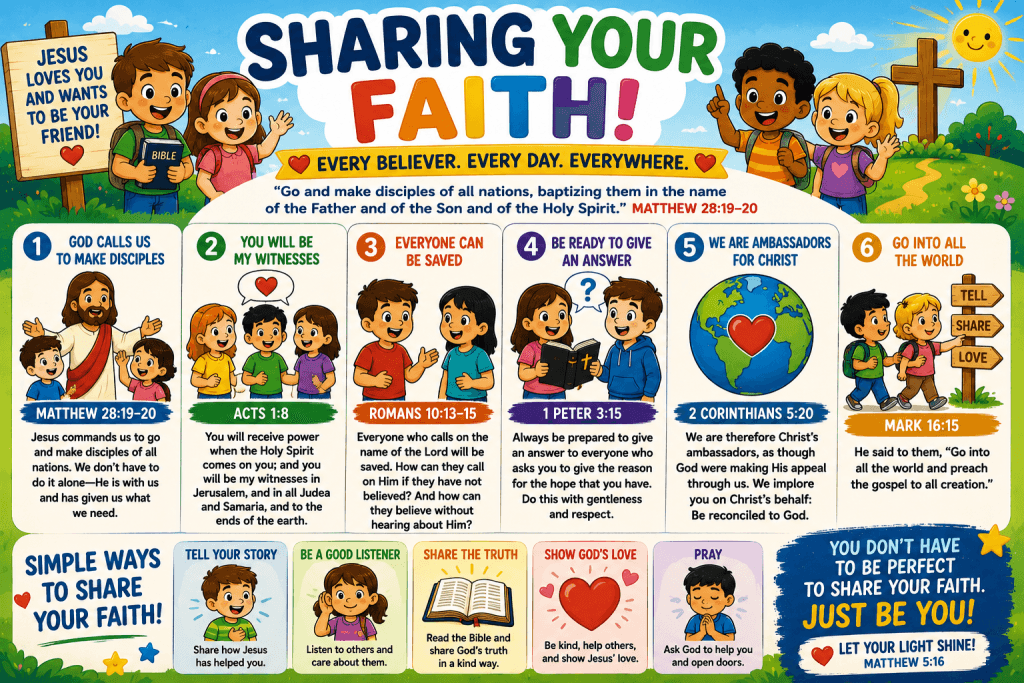
This lesson teaches that sharing your faith is a faithful next step for every disciple of Jesus. Matthew 28:19–20 provides the foundation by giving believers the Great Commission: to make disciples, baptize, and teach obedience to Christ. Evangelism is not separated from discipleship. The goal is not simply to win arguments or collect decisions, but to help people come to Christ and grow as followers of Him.Acts 1:8 teaches that believers witness through the power of the Holy Spirit. The mission does not depend on human confidence alone, but on God's enabling presence. Romans 10:13–15 shows the urgency of gospel proclamation because people must hear the message of Christ in order to call on Him. 1 Peter 3:15 teaches believers to be ready to explain their hope with gentleness and respect. 2 Corinthians 5:20 reminds Christians that they are ambassadors for Christ, entrusted with the message of reconciliation. Mark 16:15 reinforces the call to proclaim the gospel broadly, keeping the good news of Jesus at the center.The big idea of this adult lesson is that believers are called to move from privately holding faith to actively sharing faith. Sharing the gospel is an act of obedience, love, and trust in God. The next faithful step is to identify one person, pray for them, and look for a natural opportunity to share the hope of Christ with clarity, gentleness, and bold faith.Adult Questions
- Across the full lesson, what truths do you see about the mission Jesus gives His followers?Your personal thoughts are private and are not shared.
- How does the Great Commission shape the way believers think about evangelism, discipleship, and everyday relationships?Your personal thoughts are private and are not shared.
- What makes sharing your faith difficult for you: fear, lack of confidence, not knowing what to say, past rejection, or spiritual discouragement?Your personal thoughts are private and are not shared.
- What is one practical way you can be a faithful witness for Christ this week?Your personal thoughts are private and are not shared.
- How can this group pray for, encourage, and hold one another accountable in sharing the gospel with gentleness, boldness, and love?Your personal thoughts are private and are not shared.
Adult Prayer

Scripture Reading
- These notes are personal and are not shared.
- These notes are personal and are not shared.
- These notes are personal and are not shared.
- These notes are personal and are not shared.
- These notes are personal and are not shared.
- These notes are personal and are not shared.
Youth Explanation
After Jesus rose from the dead, He gave His followers a mission. He told them to go and make disciples. This means helping people know Jesus, follow Him, and learn to obey His Word. Sharing your faith is not only for pastors, missionaries, or adults. Teenagers who follow Jesus are also called to point others to Him. Jesus also promised that He would be with His people as they obey His mission.
Focus on the Scripture
The main command is to make disciples. Teenagers should notice that Jesus does not only say to believe quietly. He sends His followers to help others know and follow Him. This matters because sharing your faith is part of growing as a disciple.
Youth Application
* Pray for one person who needs to know Jesus.
* Look for natural chances to talk about your faith at school, home, or online.
* Invite a friend to church, youth group, or a Bible study.
* Remember that Jesus is with you when sharing your faith feels scary.
* Help newer believers grow instead of leaving them to figure faith out alone.
Youth Summary
Sharing your faith means helping others hear, understand, and respond to the good news of Jesus. Matthew 28:19–20 teaches that Jesus sends His followers to make disciples and promises to be with them. Acts 1:8 reminds believers that the Holy Spirit gives power to be witnesses. Romans 10:13–15 shows that people need to hear the gospel so they can call on the Lord. 1 Peter 3:15 teaches believers to be ready to explain their hope with gentleness and respect. 2 Corinthians 5:20 reminds Christians that they represent Christ as ambassadors. Mark 16:15 calls believers to proclaim the gospel.The big idea is that sharing your faith is part of following Jesus. Teenagers do not have to know every answer or be fearless before they can witness. They can depend on the Holy Spirit, speak the truth in love, and point people to Jesus in everyday life. This week, pray for one person, look for one opportunity, and take one faithful step to share the hope of Christ.Youth Questions
- What do these passages teach about the mission Jesus gives His followers?Your personal thoughts are private and are not shared.
- How is sharing your faith different from just being a nice person or quietly believing in Jesus?Your personal thoughts are private and are not shared.
- What makes it hard for you to talk about Jesus with others?Your personal thoughts are private and are not shared.
- What is one practical way you can be a witness for Christ this week?Your personal thoughts are private and are not shared.
- How can this group pray for and encourage each other to share the gospel with boldness, gentleness, and love?Your personal thoughts are private and are not shared.
Youth Prayer
Scripture Reading
- These notes are personal and are not shared.
- These notes are personal and are not shared.
- These notes are personal and are not shared.
- These notes are personal and are not shared.
- These notes are personal and are not shared.
- These notes are personal and are not shared.
Children Explanation
After Jesus rose from the dead, He gave His followers an important job. He told them to help other people know Him and follow Him. This is called making disciples. Children can share their faith too. They can tell others about Jesus, invite someone to church, obey God, and show His love.
Focus on the Scripture
The main command is to help others follow Jesus. Children should notice that Jesus promised to be with His people. This helps children be brave, obey Jesus, and tell others about Him.
Children Application
* Pray for someone who needs to know Jesus.
* Invite a friend to church or children’s class.
* Tell someone that Jesus loves them.
* Obey Jesus so others can see His love in you.
* Remember that Jesus is with you.
Children Summary
Sharing your faith means telling others the good news about Jesus. Matthew 28:19–20 teaches that Jesus sends His followers to help others know and follow Him. Acts 1:8 teaches that the Holy Spirit helps believers be witnesses. Romans 10:13–15 teaches that people need to hear about Jesus so they can call on Him. 1 Peter 3:15 teaches us to answer with kindness and respect. 2 Corinthians 5:20 teaches that believers are messengers for Christ. Mark 16:15 teaches us to tell the good news.The big lesson is that children can share Jesus too. They can pray, invite, speak kindly, tell the truth, and show God’s love. Jesus is with His people and helps them be brave witnesses.Children Questions
- What did this lesson teach us about sharing our faith?Your personal thoughts are private and are not shared.
- Why do people need to hear the good news about Jesus?Your personal thoughts are private and are not shared.
- When does it feel hard to talk about Jesus?Your personal thoughts are private and are not shared.
- What is one way you can share Jesus this week?Your personal thoughts are private and are not shared.
- How can we pray for each other to be brave and kind witnesses?Your personal thoughts are private and are not shared.
Children Prayer
Ready to Finish?
Mark this lesson complete to update your My Harvest progress.