Becoming Part of God’s Family

Lesson Information
This lesson helps learners understand the next faithful steps after responding to Christ. Using Ephesians 2:19–22 as the foundation, the lesson explains that growing in faith is not a one-time decision but a daily walk with Jesus through Faith, Trusting God, Obedience, Perseverance, and Walking with Christ. Learners will be encouraged to move from simply knowing about faith to actively living as disciples who trust God, obey His Word, stay connected to the church, and help others follow Christ.
Content

Scripture Reading
- These notes are personal and are not shared.
- These notes are personal and are not shared.
- These notes are personal and are not shared.
- These notes are personal and are not shared.
- These notes are personal and are not shared.
- These notes are personal and are not shared.
Adult Passage 1
19 So then you are no longer strangers and aliens, but you are fellow citizens with the saints, and are of God’s household,
20 having been built on the foundation of the apostles and prophets, Christ Jesus Himself being the corner stone,
21 in whom the whole building, being fitted together, is growing into a holy temple in the Lord,
22 in whom you also are being built together into a dwelling of God in the Spirit.
Adult Explanation
Paul wrote Ephesians to help believers understand the blessings they have received through Christ and how those blessings shape their daily lives. In chapter 2, Paul explains that both Jews and Gentiles have been reconciled to God through Jesus. Because of Christ, believers are no longer separated from God's people or treated as outsiders. Instead, they have become members of God's household. Paul uses the images of a family, a building, and a temple to show how believers are united together in Christ. This passage teaches that salvation brings people not only into a relationship with God but also into a relationship with His church.
Focus on the Scripture
The main truth of this passage is that believers belong to God's family and are being built together into a dwelling place for God. Christians should pay close attention to the words that describe belonging, unity, and spiritual growth. This passage matters because following Christ was never intended to be a solitary journey. God places believers into a church family where they can worship, grow, serve, and encourage one another.
Adult Exegesis
Keyword Study
Household (Greek: *oikeios*) — Refers to members of a family or household. Paul uses this word to emphasize the close relationship believers share as God's family.
Built Together (Greek: *sunoikodomeō*) — To be joined together in construction. This word pictures believers being united and strengthened together as God builds His church.
Paul begins by declaring that believers are no longer strangers and aliens. Through Christ, barriers that once separated people have been removed. Every believer shares the same access to God and the same place within His family. This truth creates unity because the church is built on God's grace rather than human status, background, or achievement.
The imagery of a building highlights both stability and growth. The church is founded upon the teaching of the apostles and prophets, with Jesus Christ as the cornerstone. A cornerstone determined the alignment and strength of the entire structure. In the same way, Christ remains the foundation and standard for everything the church believes and practices.
Paul also describes believers as a holy temple in the Lord. Under the old covenant, God's presence was associated with a physical temple. Under the new covenant, God's Spirit dwells among His people. This reminds believers that church membership is more than attending services; it is participating in God's ongoing work of building His people together for His glory.
Adult Application
* Invest in meaningful relationships within your local church family.
* Look for opportunities to encourage and support fellow believers.
* Remember that every Christian belongs to God's household regardless of background.
* Serve faithfully in ways that strengthen unity and spiritual growth in the church.
* Keep Christ at the center of your decisions, relationships, and ministry efforts.
Adult Passage 2
42 They were continually devoting themselves to the apostles’ teaching and to fellowship, to the breaking of bread and to prayer.
43 Everyone kept feeling a sense of awe; and many wonders and signs were taking place through the apostles.
44 And all those who had believed were together and had all things in common;
45 and they began selling their property and possessions and were sharing them with all, as anyone might have need.
46 Day by day continuing with one mind in the temple, and breaking bread from house to house, they were taking their meals together with gladness and sincerity of heart,
47 praising God and having favor with all the people. And the Lord was adding to their number day by day those who were being saved.
Adult Explanation
These verses describe the life of the early church immediately after thousands of people trusted Christ on the Day of Pentecost. The new believers devoted themselves to spiritual growth, fellowship, worship, prayer, and caring for one another. Their faith was not limited to a weekly gathering but affected every part of their lives. As they followed Christ together, God used their witness to draw more people into His family. This passage provides a powerful picture of what church life should look like when believers are committed to one another and to the mission of Christ.
Focus on the Scripture
The primary focus of this passage is the devotion of believers to spiritual growth and community. Christians should pay close attention to the practices that shaped the early church: biblical teaching, fellowship, worship, prayer, generosity, and unity. This passage matters because healthy spiritual growth often happens in the context of faithful relationships with other believers.
Adult Exegesis
Keyword Study
Devoted (Greek: *proskartereō*) — To persist, continue steadfastly, or remain committed. This word reflects intentional and consistent dedication.
Fellowship (Greek: *koinōnia*) — Sharing, partnership, or participation together. It describes the close spiritual relationships believers share in Christ.
The early church understood that faith was meant to be lived in community. They devoted themselves to the apostles' teaching because spiritual growth requires truth. They devoted themselves to fellowship because believers need one another for encouragement, accountability, and support. Their commitment was not occasional but consistent.
The passage also highlights generosity and care for others. Believers willingly shared resources to meet needs within the church family. This demonstrated that their unity was not merely theoretical. Their love for one another produced visible action. A healthy church family reflects God's love through practical service and compassion.
As believers worshiped, prayed, learned, and served together, God worked powerfully among them. Their unity and devotion became a testimony to those around them. This reminds modern believers that church is not merely an event to attend but a spiritual family where disciples grow together and help others follow Christ.
Adult Application
* Prioritize regular involvement in worship, Bible study, and prayer with your church family.
* Build deeper relationships with believers beyond Sunday services.
* Look for practical ways to meet needs within your church community.
* Participate actively instead of viewing church as something to observe.
* Encourage others in their faith through prayer, service, and friendship.
Adult Passage 3
24 and let us consider how to stimulate one another to love and good deeds,
25 not forsaking our own assembling together, as is the habit of some, but encouraging one another; and all the more as you see the day drawing near.
Adult Explanation
The book of Hebrews was written to encourage believers who were facing pressure, hardship, and the temptation to drift away from their faith. In this passage, the writer emphasizes the importance of gathering together and encouraging one another. The Christian life includes challenges, discouragements, temptations, and seasons of weakness. God designed the church to help believers remain faithful. This passage teaches that spiritual growth and perseverance are strengthened when Christians actively invest in one another.
Focus on the Scripture
The discipleship focus of this passage is encouraging one another toward love, good deeds, and faithful commitment to Christ. Believers should pay close attention to the call not to neglect gathering together. This passage matters because isolation often weakens faith, while healthy church relationships strengthen believers to continue following Christ.
Adult Exegesis
Keyword Study
Consider (Greek: *katanoeō*) — To carefully think about, observe, or pay close attention. Believers are called to intentionally think about how they can help others grow.
Encourage (Greek: *parakaleō*) — To exhort, comfort, strengthen, or urge forward. This word emphasizes active support and spiritual encouragement.
The writer calls believers to think intentionally about how they can stir one another to love and good deeds. This moves church involvement beyond personal benefit. Christians are not only recipients of encouragement but also participants in helping others grow. Every believer has a role in strengthening the body of Christ.
The warning against neglecting assembly highlights the importance of consistent fellowship. Gathering with other believers provides opportunities for worship, learning, accountability, prayer, and mutual encouragement. Isolation often leaves believers more vulnerable to discouragement and temptation.
The passage also connects encouragement with perseverance. As believers see the challenges of life and anticipate Christ's return, they are called to strengthen one another. Church fellowship helps believers remain faithful during difficult seasons and reminds them of God's promises and purposes.
Adult Application
* Make gathering with your church family a regular priority.
* Look for someone you can intentionally encourage this week.
* Reach out to believers who may be struggling, isolated, or discouraged.
* Use your words to build others up rather than criticize or discourage.
* View church attendance as an opportunity to strengthen others, not just receive encouragement.
Adult Passage 4
12 For even as the body is one and yet has many members, and all the members of the body, though they are many, are one body, so also is Christ.
13 For by one Spirit we were all baptized into one body, whether Jews or Greeks, whether slaves or free, and we were all made to drink of one Spirit.
14 For the body is not one member, but many.
15 If the foot says, “Because I am not a hand, I am not a part of the body,” it is not for this reason any the less a part of the body.
16 And if the ear says, “Because I am not an eye, I am not a part of the body,” it is not for this reason any the less a part of the body.
17 If the whole body were an eye, where would the hearing be? If the whole were hearing, where would the sense of smell be?
18 But now God has placed the members, each one of them, in the body, just as He desired.
19 If they were all one member, where would the body be?
20 But now there are many members, but one body.
21 And the eye cannot say to the hand, “I have no need of you”; or again the head to the feet, “I have no need of you.”
22 On the contrary, it is much truer that the members of the body which seem to be weaker are necessary;
23 and those members of the body which we deem less honorable, on these we bestow more abundant honor, and our less presentable members become much more presentable,
24 whereas our more presentable members have no need of it. But God has so composed the body, giving more abundant honor to that member which lacked,
25 so that there may be no division in the body, but that the members may have the same care for one another.
26 And if one member suffers, all the members suffer with it; if one member is honored, all the members rejoice with it.
27 Now you are Christ’s body, and individually members of it.
Adult Explanation
Paul wrote 1 Corinthians to a church that struggled with division, pride, immaturity, and misunderstanding about spiritual gifts. In chapter 12, he explains that the church is like one body with many different parts. Every believer has a place, and every believer matters. No Christian should think they are unnecessary, and no Christian should think they are more important than others. This passage teaches that becoming part of God’s family means learning to belong, serve, depend on one another, and value the different ways God works through His people.
Focus on the Scripture
The main truth of this passage is that believers are one body in Christ, and each member has a meaningful role. Christians should pay attention to both unity and diversity. The church is not made strong by everyone being the same, but by every believer serving together under Christ. This matters for spiritual growth because God uses the church family to teach humility, service, love, and mutual care.
Adult Exegesis
Keyword Study
Body (Greek: *sōma*) — Refers to the physical body, but Paul uses it as an image for the church. It shows that believers are connected, dependent on one another, and meant to function together.
Member (Greek: *melos*) — A part or limb of the body. This word helps explain that each believer has a real place and purpose within the church.
Paul’s body illustration confronts pride and discouragement at the same time. Some believers may feel superior because of their gifts, roles, or visibility. Others may feel unnecessary because their service seems small or unseen. Paul shows that both attitudes misunderstand the church. God arranges the body according to His wisdom, and every member has value.
This passage also teaches that Christian unity does not erase difference. The body needs many parts to function well. In the same way, the church needs believers with different gifts, backgrounds, experiences, and responsibilities. The goal is not competition but cooperation. Every gift is meant to serve the whole body.
Paul also emphasizes shared care. When one member suffers, the body is affected. When one member is honored, the body rejoices. This reflects the deep fellowship God intends for His people. Becoming part of God’s family means moving beyond individual faith into shared life, shared burdens, and shared mission.
Adult Application
* Recognize that your presence and service matter in the church family.
* Avoid comparing your role with someone else’s role; serve faithfully where God has placed you.
* Look for members of the church who may feel unseen, discouraged, or disconnected.
* Practice unity by celebrating the gifts and service of others instead of competing.
* Care for fellow believers in practical ways when they are hurting, struggling, or rejoicing.
Adult Passage 5
4 For just as we have many members in one body and all the members do not have the same function,
5 so we, who are many, are one body in Christ, and individually members one of another.
Adult Explanation
Romans 12 begins the practical section of Paul’s letter, where he explains how believers should live in light of God’s mercy. After calling Christians to offer themselves to God and be transformed by the renewing of their minds, Paul teaches about humility and life within the body of Christ. These verses remind believers that they are not isolated followers of Jesus. They are members of one body and members of one another. Becoming part of God’s family means accepting both personal responsibility and spiritual connection within the church.
Focus on the Scripture
The main truth of this passage is that believers belong to one another in the body of Christ. Christians should pay attention to the phrase “members of one another” because it challenges individualism. Spiritual growth is not only personal; it is shared. This matters because God designed believers to grow through relationships, service, accountability, encouragement, and unity within the church family.
Adult Exegesis
Keyword Study
One Body (Greek: *hen sōma*) — A unified body made up of many members. Paul uses this phrase to show that believers are joined together in Christ.
Members (Greek: *melos*) — Parts of a body. In this passage, it emphasizes that each believer has a role and is connected to other believers.
Paul’s teaching flows from the mercy of God. Because believers have received grace, they are called to live humbly and faithfully with one another. The church is not a collection of disconnected individuals with separate spiritual lives. It is a body where each person’s faithfulness affects the health of the whole.
The phrase “members of one another” is especially important. It means believers have responsibilities toward each other. A Christian’s gifts, time, encouragement, wisdom, and service are not meant for personal benefit alone. They are given for the strengthening of the church family.
This passage also calls believers away from spiritual self-sufficiency. No Christian has every gift, every strength, or every perspective. God uses the body of Christ to help His people mature. The church becomes a place where believers learn humility, patience, love, and faithful service.
Adult Application
* View church involvement as belonging to a family, not simply attending an event.
* Ask how your gifts, time, and encouragement can strengthen others in the body.
* Practice humility by remembering that you need other believers and they need you.
* Build relationships that allow for encouragement, accountability, and prayer.
* Serve in ways that promote unity rather than personal recognition.
Adult Passage 6
8 Above all, keep fervent in your love for one another, because love covers a multitude of sins.
9 Be hospitable to one another without complaint.
10 As each one has received a special gift, employ it in serving one another as good stewards of the manifold grace of God.
Adult Explanation
Peter wrote to believers who were experiencing hardship and pressure because of their faith. In this section, he encourages Christians to live faithfully as people who know that Christ’s return gives urgency and purpose to their daily lives. He calls believers to love one another deeply, show hospitality, and use their gifts to serve. This passage shows that being part of God’s family is not only about receiving care but also about giving care. God gives every believer grace to steward for the good of others.
Focus on the Scripture
The discipleship focus of this passage is loving and serving one another as faithful stewards of God’s grace. Believers should pay attention to the connection between love, hospitality, and gifts. Church family life is strengthened when Christians use what God has given them to bless others. This matters for spiritual growth because serving others helps believers reflect Christ’s love in practical, visible ways.
Adult Exegesis
Keyword Study
Fervent (Greek: *ektenēs*) — Earnest, constant, or stretched out. Peter uses this word to describe love that is active, persistent, and sincere.
Stewards (Greek: *oikonomos*) — Managers or caretakers entrusted with something that belongs to another. Believers are stewards of God’s grace, using His gifts for His purposes.
Peter places love at the center of church family life. Fervent love is not casual or shallow. It is the kind of love that continues through inconvenience, conflict, weakness, and need. This love helps preserve unity because it is willing to forgive, bear burdens, and seek the good of others.
Hospitality is one practical expression of love. In Peter’s day, hospitality often involved opening homes and sharing resources with believers who were traveling, displaced, or in need. For the church today, hospitality includes welcoming others, making room for people, and caring for those who may feel alone or overlooked.
Peter also teaches that every believer has received a gift to use in service. Spiritual gifts are not possessions for personal pride but responsibilities to steward. God’s grace is displayed when believers serve one another faithfully. Becoming part of God’s family means asking not only, “Where do I belong?” but also, “How can I serve?”
Adult Application
* Practice sincere love by forgiving, encouraging, and bearing with fellow believers.
* Look for ways to show hospitality to someone who may feel disconnected or alone.
* Identify the gifts, abilities, or resources God has entrusted to you for serving others.
* Serve without grumbling, remembering that ministry is stewardship of God’s grace.
* Strengthen church unity by choosing love and service over criticism or self-focus.
Adult Summary
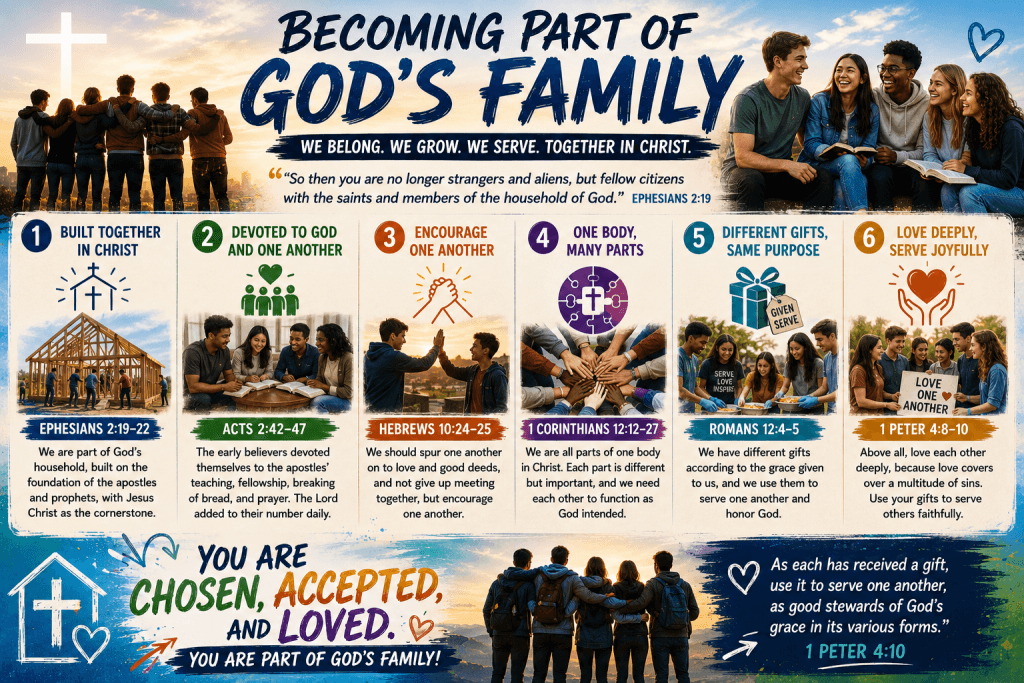
This lesson teaches that becoming part of God’s family is one of the faithful next steps in following Christ. Ephesians 2:19–22 provides the foundation by showing that believers are no longer strangers or outsiders but members of God’s household. Through Christ, God brings His people together and builds them into a holy dwelling place where His Spirit is present. Belonging to God includes belonging to His people.Acts 2:42–47 shows the early church devoted to biblical teaching, fellowship, worship, prayer, generosity, and shared life. Their faith was not isolated but lived together in visible community. Hebrews 10:24–25 reminds believers not to neglect gathering together but to encourage one another toward love, good deeds, and perseverance. 1 Corinthians 12:12–27 teaches that the church is one body with many members, and every believer has value and purpose. Romans 12:4–5 reinforces that Christians are members of one another, connected in Christ and responsible to serve the body. 1 Peter 4:8–10 calls believers to love deeply, show hospitality, and use their gifts as faithful stewards of God’s grace.The big idea of this adult lesson is that the Christian life was never meant to be lived alone. God saves individuals into a family where they grow, worship, serve, encourage, and persevere together. The next faithful step is to move from simply attending church to actively belonging to the church family. Adults should look for one concrete way this week to strengthen fellowship, serve others, build unity, or encourage someone in Christ.Adult Questions
- What repeated truths do you see in this lesson about belonging to God’s family and living as part of the church?Your personal thoughts are private and are not shared.
- How does Scripture describe the church as more than a place people attend on Sundays?Your personal thoughts are private and are not shared.
- Where do you personally find it most challenging to live as part of God’s family: belonging, unity, fellowship, serving, encouragement, or caring for others?Your personal thoughts are private and are not shared.
- What is one practical way you can strengthen the church family this week through service, encouragement, hospitality, or prayer?Your personal thoughts are private and are not shared.
- How can this group help one another feel connected, use our gifts faithfully, and grow together in Christ?Your personal thoughts are private and are not shared.
Adult Prayer
Scripture Reading
- These notes are personal and are not shared.
- These notes are personal and are not shared.
- These notes are personal and are not shared.
- These notes are personal and are not shared.
- These notes are personal and are not shared.
- These notes are personal and are not shared.
Youth Explanation
Paul teaches that people who trust Jesus are no longer outsiders. They become part of God’s household, which means they belong to God’s family. The church is not just a building or a weekly event. It is God’s people being built together with Jesus as the foundation. For teenagers, this matters because many people struggle with feeling left out, unseen, or disconnected. In Christ, believers belong to God and to His people.
Focus on the Scripture
The main truth is that believers belong to God’s family and are being built together in Christ. Teenagers should notice that following Jesus is not meant to be done alone. This passage matters because spiritual growth happens as believers stay connected to Christ and to the church family.
Youth Application
* Remember that your place in God’s family is based on Christ, not popularity or performance.
* Stay connected to church instead of trying to follow Jesus alone.
* Look for someone who feels left out and help them feel welcomed.
* Build unity by choosing encouragement instead of gossip or drama.
* Ask God to help you grow as part of His people.
Youth Summary
Becoming part of God’s family means believers belong to God and to one another. Ephesians 2:19–22 teaches that Christians are no longer outsiders but members of God’s household, built together with Jesus as the foundation. Acts 2:42–47 shows the early church learning, praying, worshiping, sharing, and caring for each other. Hebrews 10:24–25 reminds believers to keep gathering and encouraging one another. 1 Corinthians 12:12–27 teaches that the church is one body with many members, and every believer matters. Romans 12:4–5 shows that Christians are connected to one another in Christ. 1 Peter 4:8–10 calls believers to love deeply, welcome others, and use their gifts to serve.The big idea is that following Jesus was never meant to be done alone. Teenagers are not too young to belong, encourage, serve, and help build up the church family. This week, take one step from simply attending church toward truly belonging: encourage someone, welcome someone, serve somewhere, pray with someone, or choose unity in Christ.Youth Questions
- What do these passages teach about what it means to belong to God’s family?Your personal thoughts are private and are not shared.
- How is the church different from just a building, event, or place people attend?Your personal thoughts are private and are not shared.
- Where do you struggle most with church family: belonging, serving, unity, encouragement, or staying connected?Your personal thoughts are private and are not shared.
- What is one practical way you can help strengthen your church family this week?Your personal thoughts are private and are not shared.
- How can this group help each other feel welcomed, use our gifts, and grow together in Christ?Your personal thoughts are private and are not shared.
Youth Prayer

Scripture Reading
- These notes are personal and are not shared.
- These notes are personal and are not shared.
- These notes are personal and are not shared.
- These notes are personal and are not shared.
- These notes are personal and are not shared.
- These notes are personal and are not shared.
Children Explanation
Paul teaches that people who trust Jesus are not strangers to God. They belong to God’s family. The church is not just a building. The church is God’s people. Jesus is the strong foundation, and God is building His people together. Children can know they have a place in God’s family and can grow with other believers.
Focus on the Scripture
The main truth is that believers belong to God’s family. Children should notice that Jesus brings His people together. This helps children trust God, love the church, and know they are not alone.
Children Application
* Remember that you belong to God through Jesus.
* Be kind to people at church.
* Welcome someone who feels left out.
* Listen and learn when God’s Word is taught.
* Thank God for your church family.
Children Summary
Becoming part of God’s family means believers belong to God and to one another. Ephesians 2:19–22 teaches that Christians are not strangers but members of God’s household. Acts 2:42–47 shows the first Christians learning, praying, worshiping, sharing, and helping together. Hebrews 10:24–25 teaches believers to keep meeting and encouraging one another. 1 Corinthians 12:12–27 teaches that every believer matters in the church. Romans 12:4–5 teaches that Christians are connected to one another in Jesus. 1 Peter 4:8–10 teaches us to love, welcome, and serve others.The big lesson is that children are part of God’s family too. They can love, help, pray, share, forgive, welcome others, and serve at church, home, and school. God helps His children grow together as they follow Jesus.Children Questions
- What did this lesson teach us about God’s family?Your personal thoughts are private and are not shared.
- Why does God want believers to grow together in the church?Your personal thoughts are private and are not shared.
- When is it hard for you to love, serve, forgive, or welcome others?Your personal thoughts are private and are not shared.
- What is one way you can help your church family this week?Your personal thoughts are private and are not shared.
- How can we pray for each other as we learn to belong, serve, and grow together?Your personal thoughts are private and are not shared.
Children Prayer
Ready to Finish?
Mark this lesson complete to update your My Harvest progress.