Developing a Daily Walk with God

Lesson Information
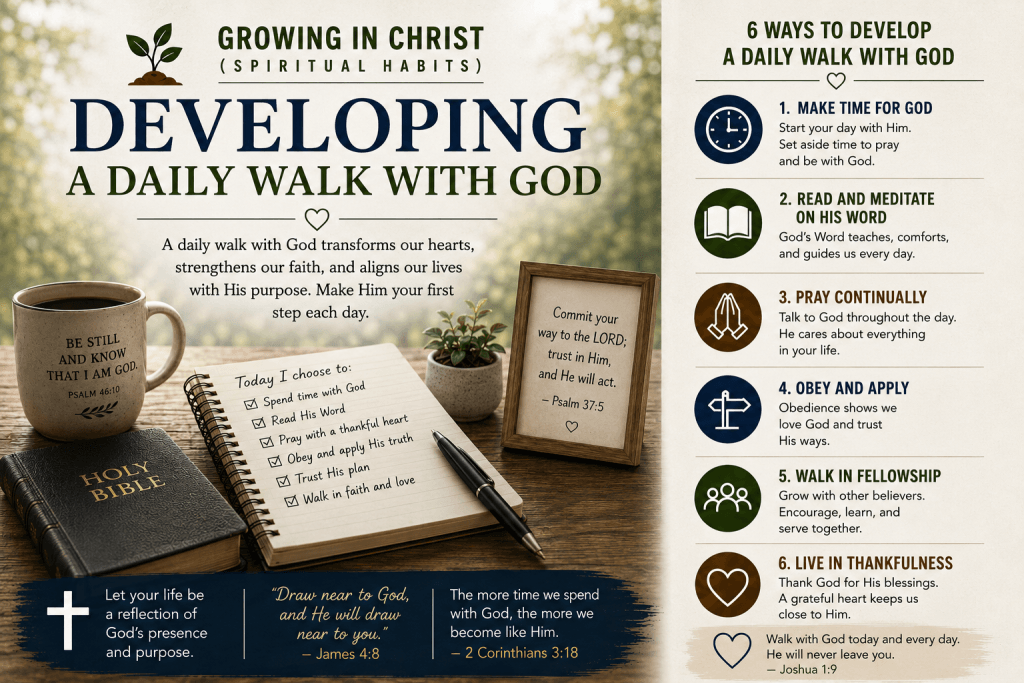
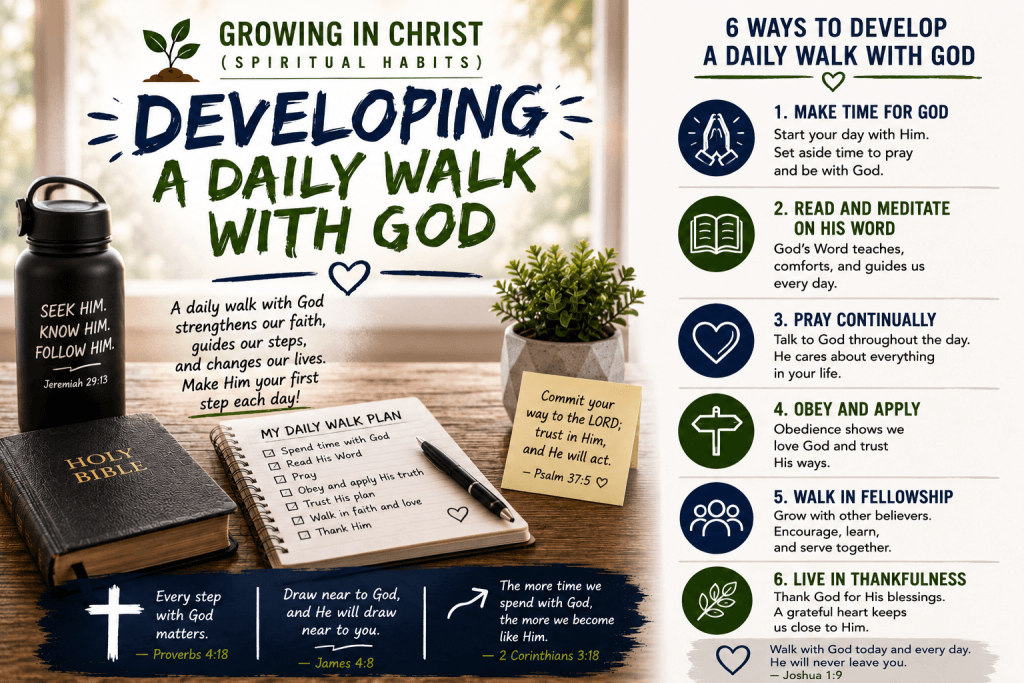
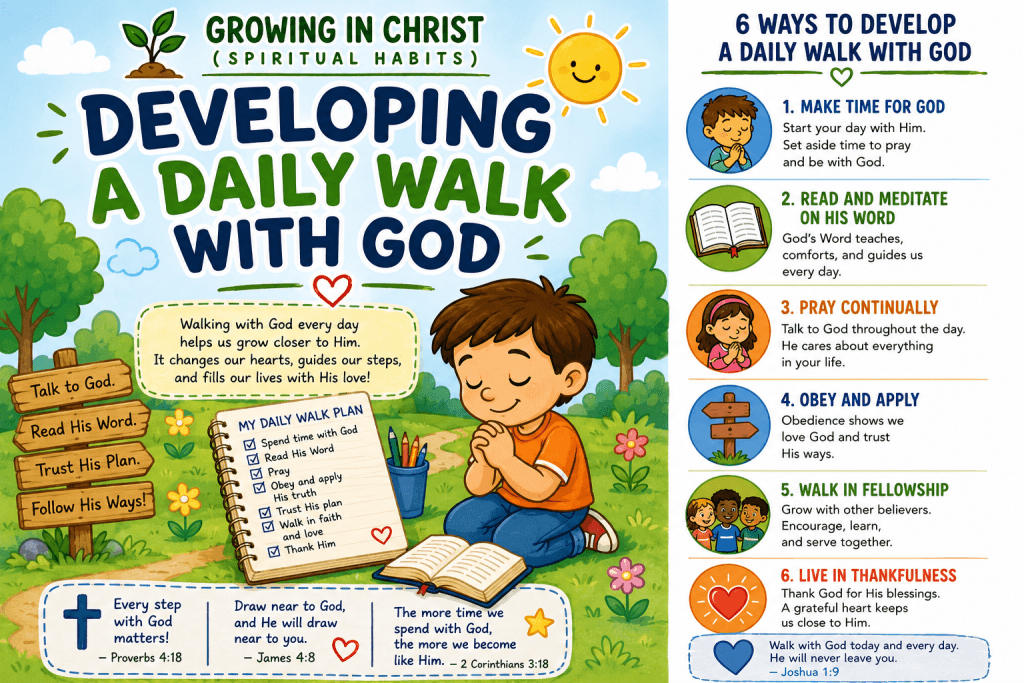
This lesson helps learners understand Developing a Daily Walk with God through the truth of Scripture. Using John 15:4–5 as the foundation, the lesson connects biblical meaning with everyday discipleship so adults, youth, and children can understand what God says, why it matters, and how to live it out through Abiding, Prayer, Scripture, Faithfulness, and Growth.
Content
Scripture Reading
- These notes are personal and are not shared.
- These notes are personal and are not shared.
- These notes are personal and are not shared.
- These notes are personal and are not shared.
- These notes are personal and are not shared.
- These notes are personal and are not shared.
Adult Passage 1
4 Abide in Me, and I in you. As the branch cannot bear fruit of itself unless it abides in the vine, so neither can you unless you abide in Me.
5 I am the vine, you are the branches; he who abides in Me and I in him, he bears much fruit, for apart from Me you can do nothing.
Adult Explanation
Jesus spoke these words during His final teaching to His disciples before His crucifixion. He used the image of a vine and branches to explain the believer’s relationship with Him. Just as a branch receives life, nourishment, and strength from the vine, believers receive spiritual life and growth through ongoing fellowship with Christ. Jesus was preparing His followers for the time after His departure and teaching them that spiritual fruitfulness would not come through human effort alone but through remaining closely connected to Him.
Focus on the Scripture
The central truth of this passage is that believers must abide in Christ to experience spiritual growth and fruitfulness. Jesus emphasizes that apart from Him, believers can accomplish nothing of lasting spiritual value. Christians should pay close attention to the command to remain in Christ because a daily walk with God depends on continual dependence, prayer, faithfulness, and obedience. This passage teaches that spiritual growth is not produced by self-effort but by a living relationship with Jesus.
Adult Exegesis
Keyword Study
Abide — Greek: menō (MEH-no). This word means to remain, continue, dwell, or stay connected. It describes an ongoing relationship rather than a temporary experience. The word highlights the believer’s need for continual fellowship with Christ.
Fruit — Greek: karpos (KAR-pos). This word refers to produce, results, or evidence of life. Spiritually, it points to godly character, obedience, effective ministry, and growth that comes from God’s work in a believer.
The image of the vine and branches would have been familiar to Jesus’ listeners. A branch has no independent source of life. If disconnected from the vine, it withers and becomes unfruitful. Likewise, believers cannot thrive spiritually apart from Christ. The daily walk with God begins with recognizing complete dependence upon Him.
Jesus teaches that abiding is more than occasional spiritual activity. It involves regular prayer, consistent attention to God’s Word, obedience to His commands, and trust in His promises. Abiding is not passive; it is an active pursuit of fellowship with Christ that shapes every area of life.
This passage fits within the broader biblical theme of covenant relationship with God. Throughout Scripture, God calls His people to walk closely with Him. Jesus reveals that He Himself is the source of spiritual life and growth. The believer who remains in Christ experiences increasing fruitfulness because God works through that relationship to produce lasting transformation.
Adult Application
* Set aside intentional daily time for prayer and Scripture reading to strengthen your connection with Christ.
* When facing challenges at home, work, or church, seek Christ’s guidance before relying on your own wisdom.
* Evaluate whether your spiritual habits are helping you remain close to Jesus or distracting you from Him.
* Depend on God for spiritual growth rather than trusting personal strength or discipline alone.
* Ask God to produce visible spiritual fruit through your daily faithfulness and obedience.
Adult Passage 2
1 How blessed is the man who does not walk in the counsel of the wicked, Nor stand in the path of sinners, Nor sit in the seat of scoffers!
2 But his delight is in the law of the Lord, And in His law he meditates day and night.
3 He will be like a tree firmly planted by streams of water, Which yields its fruit in its season And its leaf does not wither; And in whatever he does, he prospers.
Adult Explanation
Psalm 1 serves as an introduction to the entire book of Psalms and presents two contrasting paths: the way of the righteous and the way of the wicked. The psalm describes the person who delights in God’s instruction and continually reflects upon it. Rather than being shaped by ungodly influences, the righteous person is rooted in God’s truth. The result is spiritual stability, growth, and fruitfulness. This passage shows that a daily walk with God is strengthened through consistent engagement with His Word.
Focus on the Scripture
The main emphasis is the blessing that comes from delighting in and meditating on God’s Word. Believers should pay close attention to the connection between spiritual growth and regular exposure to Scripture. This passage teaches that those who anchor their lives in God’s truth become spiritually strong, fruitful, and resilient even during difficult seasons.
Adult Exegesis
Keyword Study
Meditates — Hebrew: hagah (hah-GAH). This word means to ponder, reflect upon, speak quietly, or think deeply. It describes a continual focus on God’s truth rather than a quick or casual reading.
Delight — Hebrew: chephets (KHEH-fets). This word refers to pleasure, desire, or great enjoyment. It reveals that the righteous person values God’s Word and finds joy in it.
The progression described in the opening verses shows how influences shape a person’s life. The psalmist warns against gradually adopting ungodly thinking and behavior. Instead, believers are called to build their lives around God’s truth. Spiritual maturity grows as God’s Word becomes the foundation for decisions, priorities, and perspectives.
The picture of a tree planted by streams of water communicates stability and continual nourishment. The tree does not depend upon occasional rainfall but receives a steady supply of life-giving water. Likewise, believers who regularly feed on Scripture receive ongoing spiritual nourishment that sustains growth and endurance.
This passage complements the New Testament teaching on abiding in Christ. God’s Word is one of the primary ways believers remain connected to Him. Consistent meditation on Scripture produces wisdom, strengthens faith, and equips believers to walk faithfully in every season of life.
Adult Application
* Develop a consistent plan for reading and reflecting on Scripture each day.
* Replace ungodly influences with biblical truth that encourages faithfulness and growth.
* Spend time thinking about God’s Word throughout the day, not just during a scheduled devotional time.
* Use Scripture to guide decisions, relationships, and priorities at home and work.
* Ask God to make His Word a source of joy rather than merely a spiritual obligation.
Adult Passage 3
8 This book of the law shall not depart from your mouth, but you shall meditate on it day and night, so that you may be careful to do according to all that is written in it; for then you will make your way prosperous, and then you will have success.
Adult Explanation
Joshua received this instruction from God as he prepared to lead Israel into the Promised Land following Moses’ death. The responsibility before him was enormous, and God emphasized that success would not come primarily through military skill or leadership ability but through faithfulness to God’s Word. Joshua was commanded to keep God’s instruction continually before him, meditate on it, and obey it. This verse reveals that a strong daily walk with God requires both knowledge of Scripture and obedience to it.
Focus on the Scripture
The primary command is to meditate on God’s Word continually and carefully obey it. Believers should notice that spiritual success is connected to faithful obedience rather than worldly achievement. This passage matters because it teaches that God’s guidance, wisdom, and blessing flow from a life shaped by Scripture and faithful submission to His commands.
Adult Exegesis
Keyword Study
Meditate — Hebrew: hagah (hah-GAH). This word means to reflect, ponder, or continually think about something. It suggests ongoing attention to God’s truth throughout daily life.
Observe — Hebrew: shamar (shah-MAR). This word means to guard, keep, watch over, or carefully obey. It emphasizes intentional obedience rather than mere knowledge.
God’s instruction to Joshua demonstrates that leadership and spiritual maturity are rooted in God’s Word. Joshua would face challenges, opposition, and uncertainty, but his success depended upon remaining faithful to what God had spoken. Scripture was not intended to be an occasional resource but a constant guide.
The command to meditate day and night highlights the importance of continual engagement with God’s truth. Meditation allows Scripture to move from information to transformation. As believers repeatedly reflect on God’s Word, their thinking, desires, and decisions become increasingly aligned with His will.
This verse reinforces a major biblical principle: spiritual growth occurs when God’s people hear, remember, and obey His Word. A daily walk with God is strengthened through consistent Scripture intake, thoughtful reflection, prayerful dependence, and faithful action. God’s Word remains the foundation for wisdom, discernment, and lifelong discipleship.
Adult Application
* Read Scripture consistently and ask God how to apply it in practical ways each day.
* Memorize key verses that can guide your thinking, decisions, and responses.
* Review God’s Word during ordinary moments such as commuting, exercising, or breaks at work.
* Allow Scripture to shape your priorities before making important decisions.
* Practice immediate obedience when God’s Word clearly reveals a step of faithfulness.
Adult Passage 4
33 But seek first His kingdom and His righteousness, and all these things will be added to you.
Adult Explanation
Jesus spoke this teaching during the Sermon on the Mount, where He instructed His followers about life in the kingdom of God. In the surrounding verses, He addressed worry about food, clothing, and daily needs. Rather than allowing anxiety to rule their hearts, believers are called to seek God’s kingdom and righteousness first. This does not mean Christians ignore responsibilities, but it does mean that God’s rule, God’s priorities, and God’s ways must come before lesser concerns. A daily walk with God is strengthened when believers learn to order their lives around Him first.
Focus on the Scripture
The main command is to seek first God’s kingdom and His righteousness. Believers should pay close attention to the word “first” because it confronts misplaced priorities. This passage matters because a daily walk with God requires more than adding spiritual habits to an already crowded life. It calls believers to place God at the center of decisions, schedules, desires, relationships, work, and worship.
Adult Exegesis
Keyword Study
Seek — Greek: zēteō (zay-TEH-oh). This word means to look for, desire, pursue, or strive after. In this passage, it describes an active and ongoing pursuit of God’s kingdom rather than a casual interest.
Kingdom — Greek: basileia (bah-see-LAY-ah). This word refers to royal rule, reign, or kingdom authority. Here it points to God’s reign and priorities shaping the life of the believer.
Jesus places this command in the context of worry. Anxiety often reveals what the heart believes it must control. By calling believers to seek God’s kingdom first, Jesus redirects the heart from fear-driven living to God-centered trust. The daily walk with God grows as believers repeatedly bring their concerns under His rule.
Seeking God’s righteousness means desiring what pleases Him and living according to His ways. This includes moral integrity, faithful obedience, right relationships, humility, generosity, and dependence on the Father. The believer’s priorities are not meant to be shaped by worldly success or personal security but by God’s revealed will.
The promise connected to this command reminds believers that God knows their needs. Jesus does not promise a life without difficulty, but He does call His people to trust the Father’s care. A daily walk with God is cultivated through prayerful dependence, faithful obedience, and the repeated choice to put God first.
Adult Application
* Begin each day by asking God to order your priorities around His kingdom and righteousness.
* When worry rises, turn your concerns into prayer before allowing anxiety to direct your decisions.
* Evaluate your schedule, spending, relationships, and goals to see whether God is truly first.
* Choose faithfulness over worldly pressure when work, family, or culture compete for your devotion.
* Practice trusting God’s care while still handling responsibilities with wisdom and obedience.
Adult Passage 5
6 Therefore as you have received Christ Jesus the Lord, so walk in Him,
7 having been firmly rooted and now being built up in Him and established in your faith, just as you were instructed, and overflowing with gratitude.
Adult Explanation
Paul wrote to the Colossian believers to strengthen them against false teaching and to keep them centered on Christ. He reminds them that just as they received Christ Jesus as Lord, they must continue walking in Him. Christian growth does not move beyond Christ into something more advanced; it grows deeper in Him. Paul uses images of walking, being rooted, being built up, and being established in faith to describe a steady life of discipleship. A daily walk with God is not built on novelty or spiritual shortcuts but on continuing faithfully in Christ.
Focus on the Scripture
The discipleship focus is continuing to walk in Christ after receiving Him as Lord. Believers should pay attention to the ongoing nature of this command. The Christian life begins by faith in Christ and continues by faith in Christ. This passage matters because it teaches that daily growth comes through remaining rooted, strengthened, and thankful in Him.
Adult Exegesis
Keyword Study
Walk — Greek: peripateō (peh-ree-pah-TEH-oh). This word literally means to walk around, but it is often used figuratively to describe one’s way of life, conduct, or daily pattern of living.
Rooted — Greek: rhizoō (hrid-ZOH-oh). This word means to cause to take root or become firmly established. It describes the believer’s settled foundation in Christ.
Paul’s command to “walk” in Christ shows that discipleship is a daily pattern, not an occasional spiritual event. Receiving Christ as Lord is not separated from living under His lordship. The same faith that begins the Christian life is the faith by which believers continue growing.
The images of being rooted and built up work together. A rooted plant draws nourishment from the soil and becomes stable. A building rises securely when placed on a firm foundation. Paul teaches that believers need deep stability in Christ so they are not easily moved by false teaching, cultural pressure, discouragement, or spiritual distraction.
Thankfulness is also part of a mature daily walk. Gratitude protects the heart from pride, complaint, and spiritual forgetfulness. As believers remain rooted in Christ, grow in Scripture, continue in prayer, and remember God’s grace, they become more faithful, stable, and fruitful.
Adult Application
* Treat your relationship with Christ as a daily walk, not only a Sunday commitment or past decision.
* Stay rooted in Scripture so your faith is not easily shaken by pressure, confusion, or false teaching.
* Practice gratitude each day by naming specific evidences of God’s grace and faithfulness.
* Let Christ’s lordship shape your conduct at home, work, church, and in private habits.
* Pursue steady growth rather than chasing spiritual shortcuts, emotional highs, or novelty.
Adult Passage 6
16 Rejoice always;
17 pray without ceasing;
18 in everything give thanks; for this is God’s will for you in Christ Jesus.
Adult Explanation
Paul closes his first letter to the Thessalonian church with a series of short, practical instructions for Christian living. These believers were facing pressure and needed encouragement to remain faithful. Paul calls them to rejoice always, pray without ceasing, and give thanks in everything. These commands describe a life continually turned toward God. A daily walk with God is not limited to scheduled devotional moments; it includes an ongoing posture of joy, prayer, gratitude, and dependence throughout ordinary life.
Focus on the Scripture
The main command is to live with continual rejoicing, prayer, and thanksgiving. Believers should pay attention to the repeated, ongoing nature of these instructions. This passage matters because it shows that walking with God daily includes more than reading Scripture; it also includes remaining prayerful, grateful, and aware of God’s presence in every circumstance.
Adult Exegesis
Keyword Study
Pray — Greek: proseuchomai (pros-YOO-kho-my). This word means to pray, speak to God, or offer requests and worship to Him. It describes communication with God that includes dependence, worship, confession, and petition.
Give Thanks — Greek: eucharisteō (yoo-khah-ris-TEH-oh). This word means to express gratitude or give thanks. It points to a heart that recognizes God’s grace and faithfulness even in difficult circumstances.
Paul’s commands are brief but deeply challenging. Rejoicing always does not mean pretending life is painless. It means the believer’s joy is rooted in the Lord rather than controlled by circumstances. Christian joy flows from salvation, God’s faithfulness, and the hope believers have in Christ.
Praying without ceasing does not mean a person never does anything else. It describes a continual posture of dependence on God. Throughout the day, believers can turn their thoughts, burdens, decisions, and praise toward the Lord. This kind of prayer keeps the heart connected to God in ordinary routines and difficult moments.
Giving thanks in everything does not mean every situation is good, but it does mean God is worthy of trust in every situation. Gratitude forms faithfulness by helping believers remember God’s character, provision, and promises. Together, joy, prayer, and thanksgiving shape a daily walk with God that remains steady in both blessing and hardship.
Adult Application
* Build short moments of prayer into ordinary parts of the day, such as meals, work breaks, driving, or bedtime.
* Practice gratitude by writing down specific ways God has shown faithfulness each week.
* When facing stress or disappointment, turn first to prayer instead of complaint or panic.
* Encourage others at home, church, or work by speaking words of joy and thankfulness.
* Ask God to make prayer a continual rhythm rather than only a response to emergencies.
Adult Summary
This lesson teaches that developing a daily walk with God is rooted in abiding in Christ. John 15:4–5 provides the foundation by showing that believers must remain connected to Jesus because apart from Him they can do nothing of lasting spiritual value. Psalm 1:1–3 teaches that spiritual stability and fruitfulness grow from delighting in and meditating on God’s Word. Joshua 1:8 emphasizes continual reflection on Scripture and careful obedience. Matthew 6:33 calls believers to seek God’s kingdom and righteousness first, placing Him above worry and competing priorities. Colossians 2:6–7 teaches that believers are to continue walking in Christ, rooted and built up in Him with gratitude. 1 Thessalonians 5:16–18 shows that a daily walk with God includes ongoing joy, prayer, and thanksgiving.The big idea of the Adult lesson is that walking with God is not a once-a-week spiritual activity but a daily relationship of abiding, prayer, Scripture, faithfulness, and growth. Adults are called to remain close to Christ, be shaped by God’s Word, seek His kingdom first, and depend on Him throughout ordinary life. The next faithful step is to choose one daily rhythm that strengthens fellowship with God and to practice it consistently with prayerful dependence on Christ.Adult Questions
- Across the full lesson, what repeated patterns do you see for developing a daily walk with God?Your personal thoughts are private and are not shared.
- How does abiding in Christ help us understand that spiritual growth comes from dependence on Him rather than self-effort alone?Your personal thoughts are private and are not shared.
- What usually competes most for your attention, affection, or priorities when you are trying to walk closely with God?Your personal thoughts are private and are not shared.
- What specific daily habit could help you grow this week in abiding, prayer, Scripture, faithfulness, or spiritual growth?Your personal thoughts are private and are not shared.
- How can this group encourage one another to keep walking with God through accountability, testimony, and prayer?Your personal thoughts are private and are not shared.
Adult Prayer
Scripture Reading
- These notes are personal and are not shared.
- These notes are personal and are not shared.
- These notes are personal and are not shared.
- These notes are personal and are not shared.
- These notes are personal and are not shared.
- These notes are personal and are not shared.
Youth Explanation
Jesus used the picture of a vine and branches to teach His disciples how important it is to stay close to Him. A branch cannot grow fruit if it is cut off from the vine. In the same way, followers of Jesus cannot grow spiritually by trying to live the Christian life in their own strength. A daily walk with God begins with staying connected to Jesus through prayer, Scripture, trust, and obedience.
Focus on the Scripture
The main truth is that real spiritual growth comes from abiding in Jesus. Teenagers should pay attention to the fact that Jesus does not call His followers to just try harder by themselves. He calls them to remain close to Him. This matters because school, friends, stress, sports, activities, and online life can pull attention away from Jesus, but He is the source of true life and growth.
Youth Application
* Spend time with Jesus each day through prayer, Scripture, or quiet reflection.
* Ask Jesus for help before trying to handle stress, temptation, or pressure on your own.
* Notice what pulls your heart away from Jesus and choose one step to reconnect with Him.
* Let your choices at school, home, church, and online show that you are walking with Jesus.
* Pray for God to grow spiritual fruit in your life, such as love, patience, kindness, and faithfulness.
Youth Summary
Developing a daily walk with God means staying close to Jesus and letting Him shape everyday life. John 15:4–5 teaches that Jesus is the source of real spiritual life and growth. Psalm 1:1–3 shows that God’s Word helps believers become strong and steady. Joshua 1:8 teaches that Scripture should be remembered, thought about, and obeyed. Matthew 6:33 reminds students to seek God first instead of letting worry or other priorities lead. Colossians 2:6–7 calls believers to keep walking in Christ and grow deeper in Him. 1 Thessalonians 5:16–18 shows that prayer, joy, and thankfulness are daily habits for followers of Jesus.The main lesson is that walking with God is not only a church activity. It happens at school, at home, online, with friends, in private prayer, and during ordinary moments. Teenagers can grow by abiding in Jesus, spending time in Scripture, praying throughout the day, staying faithful, and taking one steady step closer to Him.Youth Questions
- What do these passages show us about what it means to walk with God every day?Your personal thoughts are private and are not shared.
- Why is staying close to Jesus more important than simply trying harder to be a “better Christian”?Your personal thoughts are private and are not shared.
- What most often distracts you from prayer, Scripture, faithfulness, or spending time with God?Your personal thoughts are private and are not shared.
- What is one simple daily habit you can begin this week to help you grow closer to Jesus?Your personal thoughts are private and are not shared.
- How can this group encourage each other to keep walking with God when life gets busy, stressful, or distracting?Your personal thoughts are private and are not shared.
Youth Prayer
Scripture Reading
- These notes are personal and are not shared.
- These notes are personal and are not shared.
- These notes are personal and are not shared.
- These notes are personal and are not shared.
- These notes are personal and are not shared.
- These notes are personal and are not shared.
Children Explanation
Jesus used a picture of a vine and branches to teach His friends. A branch needs to stay connected to the vine to grow fruit. Jesus said His followers need to stay close to Him too. We stay close to Jesus by praying, listening to His Word, obeying Him, and trusting Him every day.
Focus on the Scripture
The main lesson is that we need Jesus every day. Children should notice that a branch cannot grow fruit by itself, and we cannot grow in faith without Jesus. This passage helps children learn to stay close to Jesus at home, church, school, and with friends.
Children Application
* Pray and talk to Jesus each day.
* Listen to God’s Word and ask Him to help you grow.
* Ask Jesus for help when you feel upset or tempted.
* Make choices that show you are following Jesus.
* Thank Jesus for helping you stay close to Him.
Children Summary
Walking with God means staying close to Jesus every day. John 15:4–5 teaches that we need Jesus like a branch needs the vine. Psalm 1:1–3 shows that God’s Word helps us grow strong like a tree by water. Joshua 1:8 teaches us to remember and obey God’s Word. Matthew 6:33 reminds us to put God first. Colossians 2:6–7 teaches us to keep walking with Jesus and grow strong in Him. 1 Thessalonians 5:16–18 reminds us to rejoice, pray, and give thanks.The big lesson is that children can walk with God each day by praying, listening to the Bible, obeying, trusting Jesus, giving thanks, and choosing God’s way at home, school, church, and with friends.Children Questions
- What do these passages teach us about walking with God every day?Your personal thoughts are private and are not shared.
- Why do we need to stay close to Jesus like a branch stays connected to a vine?Your personal thoughts are private and are not shared.
- What helps your heart trust God, obey Him, pray, and grow?Your personal thoughts are private and are not shared.
- What is one way you can walk with God this week at home, school, church, or with friends?Your personal thoughts are private and are not shared.
- How can we pray for each other and help each other stay close to Jesus?Your personal thoughts are private and are not shared.
Children Prayer
Children Printable Images
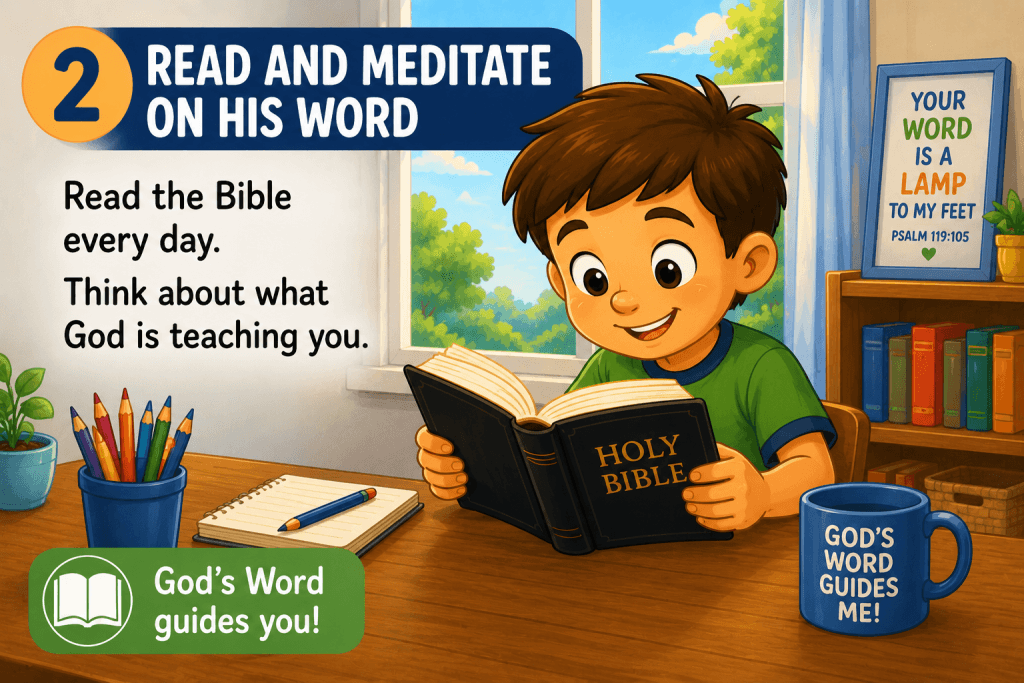
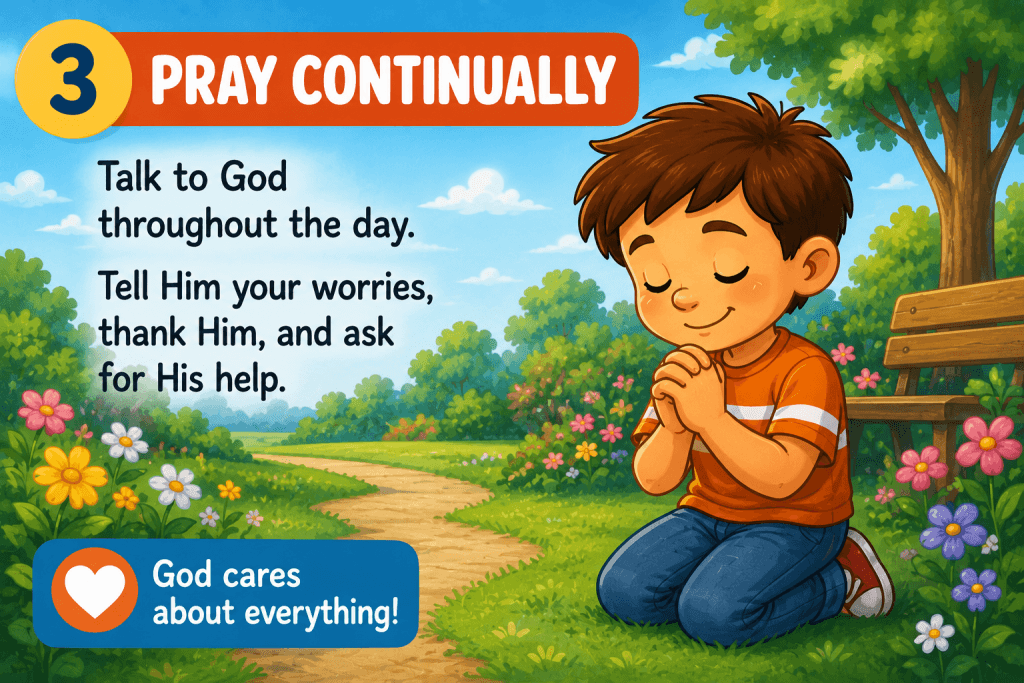
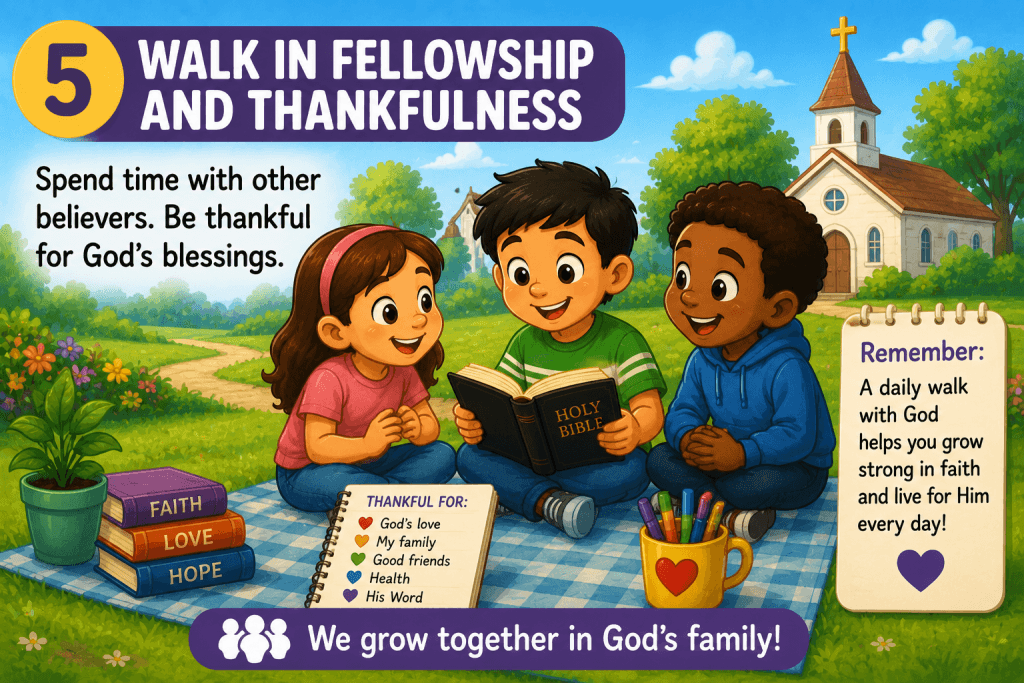
These images are provided as printable lesson pages for children.


Children Coloring Pages
These coloring pages are provided as printable activities for children.

Ready to Finish?
Mark this lesson complete to update your My Harvest progress.