How to Pray Effectively

Lesson Information
This lesson helps learners understand How to Pray Effectively through the truth of Scripture. Using Matthew 6:9–13 as the foundation, the lesson connects biblical meaning with everyday discipleship so adults, youth, and children can understand what God says, why it matters, and how to live it out through Prayer, God's Will, Confidence, Persistence, and Relationship.
Content

Scripture Reading
- These notes are personal and are not shared.
- These notes are personal and are not shared.
- These notes are personal and are not shared.
- These notes are personal and are not shared.
- These notes are personal and are not shared.
- These notes are personal and are not shared.
Adult Passage 1
9 “Pray, then, in this way: ‘Our Father who is in heaven, Hallowed be Your name.
10 Your kingdom come. Your will be done, On earth as it is in heaven.
11 Give us this day our daily bread.
12 And forgive us our debts, as we also have forgiven our debtors.
13 And do not lead us into temptation, but deliver us from evil. [For Yours is the kingdom and the power and the glory forever. Amen.’]
Adult Explanation
Matthew 6:9–13 is part of Jesus’ Sermon on the Mount, where He teaches His disciples what sincere kingdom living looks like. Just before this passage, Jesus warns against prayer that is performed to impress people and against empty repetition that treats prayer like a formula. He then gives His disciples a model prayer that teaches the priorities, posture, and heart of effective prayer. This prayer begins with God’s holiness and kingdom before moving to daily needs, forgiveness, spiritual protection, and dependence. Jesus shows that effective prayer is not measured by impressive words but by a heart rightly related to the Father and aligned with His will.
Focus on the Scripture
The central focus is learning to pray according to God’s priorities. Adults should pay close attention to the order of the prayer: worship first, God’s will above personal desires, daily dependence, forgiveness, and spiritual protection. This passage matters because effective prayer is not about getting God to follow our plans; it is about learning to trust, honor, and follow Him in every area of life.
Adult Exegesis
Keyword Study
Father — Greek: patēr (pa-TAIR). This word emphasizes personal relationship, care, authority, and belonging. Jesus teaches believers to approach God with reverence and confidence as children approaching their Father.
Kingdom — Greek: basileia (bah-see-LAY-ah). This word refers to rule, reign, or kingdom authority. Praying for God’s kingdom expresses the desire for His rule, purposes, and righteousness to be made known and obeyed.
Jesus begins prayer with God, not human need. The address to the Father holds together intimacy and reverence. Believers come near because God is Father, but they come humbly because His name is holy. Effective prayer begins when the heart is centered on who God is.
The request for God’s kingdom and will teaches surrender. Prayer is not an attempt to bend God’s will toward ours but a means by which God reshapes our desires toward His. This is essential for discipleship because mature believers learn to want God’s glory more than personal comfort or control.
The requests for daily bread, forgiveness, and deliverance show that effective prayer is practical and honest. God invites His people to bring physical needs, relational sins, spiritual weakness, and temptation before Him. This model prayer teaches believers to depend on God daily, live in restored relationships, and seek protection from evil.
Adult Application
* Begin prayer with worship and reverence before moving quickly to requests.
* Ask God to align your desires, decisions, and priorities with His will.
* Bring daily needs to God with humility instead of relying on self-sufficiency.
* Practice forgiveness as part of a healthy prayer life and restored relationships.
* Pray regularly for protection from temptation and strength to obey Christ.
Adult Passage 2
1 It happened that while Jesus was praying in a certain place, after He had finished, one of His disciples said to Him, “Lord, teach us to pray just as John also taught his disciples.”
2 And He said to them, “When you pray, say: ‘Father, hallowed be Your name. Your kingdom come.
3 Give us each day our daily bread.
4 And forgive us our sins, For we ourselves also forgive everyone who is indebted to us. And lead us not into temptation.’”
Adult Explanation
Luke 11:1–4 records the disciples asking Jesus to teach them to pray. Their request follows Jesus’ own example of prayer, showing that His personal prayer life stirred a desire in them to learn. Jesus responds with a model similar to the prayer in Matthew, emphasizing God’s holiness, His kingdom, daily provision, forgiveness, and protection from temptation. This passage shows that prayer is learned through discipleship. Effective prayer grows as believers watch Jesus, listen to His teaching, and allow Him to shape how they approach the Father.
Focus on the Scripture
The central focus is that disciples must be taught to pray. Adults should notice that the disciples did not merely ask for techniques; they wanted Jesus to shape their relationship with God. This passage matters because prayer is not simply instinctive. Believers grow in effective prayer by learning from Christ, practicing dependence, and submitting to His pattern.
Adult Exegesis
Keyword Study
Teach — Greek: didaskō (dee-DAHS-koh). This word means to teach, instruct, or train. The disciples’ request shows humility and a willingness to learn prayer from Jesus.
Forgive — Greek: aphiēmi (ah-fee-AY-mee). This word means to release, send away, forgive, or cancel a debt. In prayer, it points to both receiving God’s mercy and extending forgiveness to others.
Luke highlights the disciples’ desire to learn prayer from Jesus. This is important because prayer is not merely a religious duty; it is a learned life of communion with God. The disciples saw something in Jesus’ relationship with the Father that made them want instruction. Effective prayer begins with humility: “Lord, teach us.”
Jesus’ model keeps prayer God-centered and relational. The prayer begins with the Father and His kingdom, reminding believers that prayer is rooted in relationship and surrender. The believer is invited to bring needs before God, but always within the larger desire for God’s name to be honored and His kingdom to come.
The requests for daily bread, forgiveness, and protection show that prayer touches every part of life. God cares about daily needs, spiritual restoration, relationships, and temptation. This passage teaches adults that effective prayer is not occasional crisis language but daily dependence shaped by Jesus.
Adult Application
* Approach prayer as a disciple who still needs Jesus to teach and shape your prayer life.
* Ask God daily for provision, wisdom, and strength instead of assuming you can handle life alone.
* Receive God’s forgiveness with humility and extend forgiveness to others with obedience.
* Let Jesus’ example of prayer challenge rushed, distracted, or self-centered prayer habits.
* Build a regular rhythm of prayer that keeps your relationship with God central.
Adult Passage 3
6 Be anxious for nothing, but in everything by prayer and supplication with thanksgiving let your requests be made known to God.
7 And the peace of God, which surpasses all comprehension, will guard your hearts and your minds in Christ Jesus.
Adult Explanation
Philippians 4:6–7 was written by Paul while he was imprisoned, yet the letter is filled with joy, peace, and confidence in Christ. Near the end of the letter, Paul addresses anxiety and teaches believers how to respond to worry. Instead of being ruled by fear, Christians are commanded to bring everything to God through prayer, supplication, and thanksgiving. This passage helps adults understand that effective prayer is not only about asking correctly but also about trusting God with anxious thoughts and receiving His peace through Christ.
Focus on the Scripture
The central focus is bringing every concern to God with thanksgiving and trust. Adults should pay attention to the contrast between anxiety and prayer. This passage matters because effective prayer moves believers from carrying burdens alone to depending on God’s presence, care, and peace.
Adult Exegesis
Keyword Study
Prayer — Greek: proseuchē (pro-soo-KHAY). This word refers to worshipful communication with God. It includes reverence, dependence, and fellowship, not merely the act of making requests.
Peace — Greek: eirēnē (i-ray-NAY). This word means peace, wholeness, well-being, or tranquility. In this passage, it describes God’s guarding peace that protects the believer’s heart and mind in Christ.
Paul does not deny the reality of circumstances that create anxiety. Instead, he gives believers a faithful response to anxiety. Prayer becomes the place where fear, need, and helplessness are brought honestly before God. This means effective prayer includes real concerns, not polished religious language.
Thanksgiving is central to the passage. Gratitude reminds believers of God’s faithfulness and shifts attention from present fear to the character of the Lord. Effective prayer remembers who God has been, trusts who God is, and rests in what God can do.
The promise of peace is not presented as a guarantee that every circumstance will immediately change. Rather, God’s peace guards the inner life of the believer through Christ. This peace strengthens confidence, steadies the mind, and helps Christians live faithfully while waiting on the Lord.
Adult Application
* Bring specific anxieties to God in prayer instead of carrying them silently.
* Include thanksgiving in prayer to remember God’s past faithfulness and present care.
* Pause to pray before reacting to stress, conflict, fear, or major decisions.
* Trust God’s peace even when circumstances have not yet changed.
* Develop a prayer habit that strengthens confidence in God’s presence and care.
Adult Passage 4
14 This is the confidence which we have before Him, that, if we ask anything according to His will, He hears us.
15 And if we know that He hears us in whatever we ask, we know that we have the requests which we have asked from Him.
Adult Explanation
First John 5:14–15 comes near the close of John’s letter, where he writes to believers so they may have assurance in Christ and confidence before God. John has emphasized walking in the light, obeying God’s commands, loving fellow believers, discerning truth from error, and trusting in the Son of God. In these verses, John teaches that effective prayer is rooted in confidence before God and submission to His will. Believers do not pray as strangers hoping God might notice them. They pray as God’s children who are invited to ask, listen, trust, and rest in His wise and holy purposes.
Focus on the Scripture
The central focus is confidence in prayer according to God’s will. Adults should pay attention to the connection between boldness and surrender. Biblical confidence does not mean demanding that God do whatever we want. It means approaching Him with trust, asking in alignment with His character and purposes, and believing that He hears His people.
Adult Exegesis
Keyword Study
Confidence — Greek: parrēsia (pah-RAY-see-ah). This word means boldness, openness, freedom in speaking, or confident access. It describes the believer’s privilege of approaching God without fear because of relationship with Him through Christ.
Will — Greek: thelēma (THAY-lay-mah). This word means will, desire, purpose, or intention. In this passage, it refers to God’s wise and righteous purposes that shape how believers should pray.
John teaches that believers can approach God with confidence, but that confidence is not self-centered. Prayer is effective when it is shaped by God’s will. This does not make prayer cold or uncertain; rather, it places prayer in the safest place possible: the loving wisdom of God.
The promise that God hears His people is deeply relational. Hearing in this passage is more than awareness of sound. It expresses God’s attentive care toward those who belong to Him. Believers may not always know how God will answer, but they can know that He receives their prayers and responds according to His will.
This passage helps correct two common errors. One error is timid prayer that assumes God is distant or unwilling to hear. The other is presumptuous prayer that treats God as if He must submit to human desires. John teaches mature prayer: confident, trusting, surrendered, and shaped by God’s revealed truth.
Adult Application
* Pray with confidence because believers have access to God through Christ.
* Ask God to align your requests with His will rather than only asking Him to bless your plans.
* Let Scripture shape your prayers so your desires grow closer to God’s purposes.
* Trust that God hears you even when His answer is different from what you expected.
* Practice surrendered prayer by saying honestly, “Lord, teach me to want what honors You.”
Adult Passage 5
16 Therefore, confess your sins to one another, and pray for one another so that you may be healed. The effective prayer of a righteous man can accomplish much.
Adult Explanation
James 5:16 is part of James’ instruction about prayer, confession, healing, and care within the church community. James writes to believers whose faith must be lived out in practical obedience. He teaches that Christians should not hide sin, carry burdens alone, or treat prayer as a private habit disconnected from the body of Christ. Confession and prayer belong together because God uses humility, honesty, and faithful intercession to bring healing and restoration. This passage helps adults understand that effective prayer is not merely individual; it is also relational and connected to righteous living.
Focus on the Scripture
The central focus is the power of faithful prayer within a humble and honest community. Adults should pay attention to the connection between confession, righteousness, healing, and prayer. This passage matters because effective prayer grows in a life that is open before God, honest with trusted believers, and committed to walking in obedience.
Adult Exegesis
Keyword Study
Confess — Greek: exomologeō (ex-o-mo-lo-GEH-oh). This word means to openly acknowledge, agree, or admit. In this context, it points to honest confession of sin and need within appropriate spiritual relationships.
Effective — Greek: energeō (en-er-GEH-oh). This word means to work, be active, or produce results. It emphasizes that faithful prayer is not empty or meaningless; God works through prayer according to His will.
James connects prayer with spiritual honesty. Confession is not meant to encourage gossip, shame, or careless public exposure. It is meant to bring sin and struggle into the light with wisdom so that healing, repentance, accountability, and restoration can happen. Effective prayer grows where humility replaces hiding.
The reference to the prayer of a righteous person does not mean that only perfect people can pray effectively. Scripture teaches that righteousness is received through faith and then lived out through obedience. James is describing a life oriented toward God, not a sinless person earning influence over Him.
This passage also shows that prayer is a ministry believers offer one another. The church should be a place where people pray with compassion, not judgment; where burdens are carried, not ignored; and where restoration is pursued, not merely discussed. Effective prayer strengthens both personal faith and the life of the church.
Adult Application
* Build trusted Christian relationships where honest confession and prayer can happen wisely.
* Pray for others with seriousness, compassion, and faith in God’s ability to work.
* Refuse to hide sin in isolation; seek restoration through repentance, accountability, and grace.
* Let obedience and humility strengthen your prayer life instead of treating prayer as disconnected from daily living.
* Make prayer a normal part of caring for family, church members, and those who are struggling.
Adult Passage 6
14 Therefore, since we have a great high priest who has passed through the heavens, Jesus the Son of God, let us hold fast our confession.
15 For we do not have a high priest who cannot sympathize with our weaknesses, but One who has been tempted in all things as we are, yet without sin.
16 Therefore let us draw near with confidence to the throne of grace, so that we may receive mercy and find grace to help in time of need.
Adult Explanation
Hebrews 4:14–16 encourages believers by pointing them to Jesus as the great High Priest. The original audience was facing pressure, weakness, temptation, and the danger of drifting from faithful endurance. The writer reminds them that Jesus has passed through the heavens, fully understands human weakness, and yet remains without sin. Because of who Jesus is, believers can draw near to God’s throne with confidence. This passage teaches that effective prayer is possible because access to God is secured by Christ, not by human worthiness.
Focus on the Scripture
The central focus is confident access to God through Jesus Christ. Adults should pay close attention to the reason believers can come boldly: Jesus is the sympathetic and sinless High Priest. This passage matters because prayer is not based on how strong, worthy, or impressive a believer feels. Prayer rests on the finished work and ongoing intercession of Christ.
Adult Exegesis
Keyword Study
High Priest — Greek: archiereus (ar-khee-er-YOOS). This word refers to the chief priest who represented the people before God. Hebrews applies it to Jesus, showing that He is the perfect mediator between God and His people.
Draw Near — Greek: proserchomai (pros-ER-kho-my). This word means to approach, come near, or draw close. In Hebrews, it often describes approaching God in worship, dependence, and faith through Christ.
Hebrews presents Jesus as both exalted and compassionate. He has passed through the heavens, showing His supreme authority, yet He sympathizes with human weakness because He truly entered human experience. This gives believers strong encouragement to pray honestly rather than pretending to be stronger than they are.
The statement that Jesus was tempted yet without sin is essential. He understands temptation without being defeated by it. Therefore, He is able to help believers in weakness. Effective prayer includes coming to God for mercy when we have failed and grace when we need strength to obey.
The invitation to the throne of grace is one of the most comforting truths in Scripture. God’s throne is a place of holiness and authority, but because of Christ, believers approach it as a throne of grace. Prayer is not crawling toward a reluctant God; it is drawing near to receive mercy and grace from the Father through the Son.
Adult Application
* Come to God honestly in weakness, trusting that Jesus understands and intercedes for His people.
* Pray for mercy after failure instead of hiding in shame or self-condemnation.
* Ask for grace before temptation, hard conversations, decisions, and seasons of pressure.
* Build confidence in prayer on Christ’s priestly work, not on your emotional strength or spiritual performance.
* Encourage others who feel unworthy to draw near to God through Jesus.
Adult Summary
How to Pray Effectively begins with the model Jesus gave in Matthew 6:9–13. Effective prayer starts with worship, seeks God’s kingdom and will, depends on Him for daily needs, receives and extends forgiveness, and asks for protection from temptation and evil. Luke 11:1–4 reinforces that prayer is something disciples learn from Jesus as they grow in relationship with the Father. Philippians 4:6–7 teaches believers to bring anxiety to God with thanksgiving and to trust His peace.1 John 5:14–15 teaches that effective prayer includes confidence before God while submitting to His will. James 5:16 shows that prayer is powerful when joined with humility, confession, righteous living, and care within the church. Hebrews 4:14–16 reminds believers that confidence in prayer is possible because Jesus is the great High Priest who understands weakness and gives access to the throne of grace.Together, these passages show that effective prayer is not a technique for controlling outcomes but a relationship of trust, surrender, dependence, confidence, and persistence before God. The next faithful step is to let Jesus shape your prayer life: worship first, seek God’s will, bring needs honestly, confess humbly, pray for others, and draw near to God through Christ with confidence.Adult Questions
- What repeated truths do you see across this lesson about effective prayer, God’s will, confidence, persistence, relationship, forgiveness, and dependence?Your personal thoughts are private and are not shared.
- How does the full lesson show that effective prayer is not about impressive words, but about a heart aligned with God and trusting Him through Christ?Your personal thoughts are private and are not shared.
- Where do you most need growth in prayer right now: worship, surrender to God’s will, thanksgiving, honesty, confession, confidence, or persistence?Your personal thoughts are private and are not shared.
- What practical step can you take this week to make your prayer life more God-centered, Scripture-shaped, and consistent?Your personal thoughts are private and are not shared.
- How can this group encourage one another through prayer, accountability, testimony, and confidence in God’s grace?Your personal thoughts are private and are not shared.
Adult Prayer

Scripture Reading
- These notes are personal and are not shared.
- These notes are personal and are not shared.
- These notes are personal and are not shared.
- These notes are personal and are not shared.
- These notes are personal and are not shared.
- These notes are personal and are not shared.
Youth Explanation
Jesus taught this prayer during the Sermon on the Mount. Before this, He warned people not to pray just to look spiritual or impress others. Then He showed His followers a simple, powerful way to pray. This prayer begins with honoring God, then asks for God’s will, daily needs, forgiveness, and help against temptation. Jesus shows that effective prayer is not about using fancy words. It is about coming to God with a sincere heart, trusting Him, and wanting His will.
Focus on the Scripture
The main truth is that Jesus teaches us to pray with God first. Teenagers should notice the order of the prayer: worship God, seek His will, depend on Him, ask for forgiveness, and ask for help to obey. This matters because prayer is not just asking God to give us what we want. Prayer helps us grow in our relationship with God and learn to follow Him.
Youth Application
* Start your prayers by praising God before asking for things.
* Ask God to help your choices, attitude, friendships, and future line up with His will.
* Pray about daily needs like school, family, stress, decisions, and temptation.
* Ask God to help you forgive others instead of holding grudges.
* Pray for strength to obey God when temptation feels strong.
Youth Summary
Effective prayer is not about perfect words or sounding spiritual. It is about a real relationship with God. Matthew 6:9–13 and Luke 11:1–4 show that Jesus teaches His followers to pray by honoring God, seeking His will, depending on Him, asking for forgiveness, and asking for help against temptation. Philippians 4:6–7 teaches that we can bring anxiety and every concern to God with thanksgiving.1 John 5:14–15 reminds us to pray with confidence according to God’s will. James 5:16 shows that prayer is powerful and that believers should pray honestly with and for one another. Hebrews 4:14–16 teaches that we can come to God confidently because Jesus understands our weakness and gives us access to the Father. For teenagers, the next step is to pray honestly, trust God’s will, stay connected to Jesus, and make prayer part of everyday life at home, school, church, online, and with friends.Youth Questions
- What do these passages teach us about what effective prayer looks like?Your personal thoughts are private and are not shared.
- How is prayer more than asking God to give us what we want?Your personal thoughts are private and are not shared.
- What part of prayer is hardest for you: worship, surrender, honesty, waiting, confession, or confidence?Your personal thoughts are private and are not shared.
- What is one practical way you can make prayer more regular and sincere this week?Your personal thoughts are private and are not shared.
- How can this group help one another grow through prayer, encouragement, accountability, and trust in God?Your personal thoughts are private and are not shared.
Youth Prayer

Scripture Reading
- These notes are personal and are not shared.
- These notes are personal and are not shared.
- These notes are personal and are not shared.
- These notes are personal and are not shared.
- These notes are personal and are not shared.
- These notes are personal and are not shared.
Children Explanation
Jesus taught His followers how to pray. He showed them that prayer starts with honoring God. Then we can ask God to help us do His will, give us what we need, forgive us, and help us do what is right. Prayer is not about fancy words. Prayer is talking to God with a true heart.
Focus on the Scripture
The main lesson is that Jesus teaches us how to pray. Children should remember that prayer helps us praise God, trust Him, ask for help, forgive others, and obey Him.
Children Application
* Start prayer by telling God something good about Him.
* Ask God to help you obey Him today.
* Pray for what you need at home, school, or church.
* Ask God to forgive you when you sin.
* Ask God to help you forgive others.
Children Summary
Prayer means talking to God. Jesus teaches us how to pray with love, trust, and honest hearts. We can praise God, ask for help, pray for God’s will, ask for forgiveness, and pray for others. When we are worried, we can talk to God. When we need help, Jesus helps us come to God with confidence. Children can pray anywhere and anytime because God hears His children and loves them.Children Questions
- What did Jesus teach us about prayer?Your personal thoughts are private and are not shared.
- Why can we talk to God when we are worried, sorry, or need help?Your personal thoughts are private and are not shared.
- What is something you want to trust God with this week?Your personal thoughts are private and are not shared.
- When can you pray this week at home, school, church, or with your family?Your personal thoughts are private and are not shared.
- Who can we pray for together today?Your personal thoughts are private and are not shared.
Children Prayer
Children Printable Images
These images are provided as printable lesson pages for children.
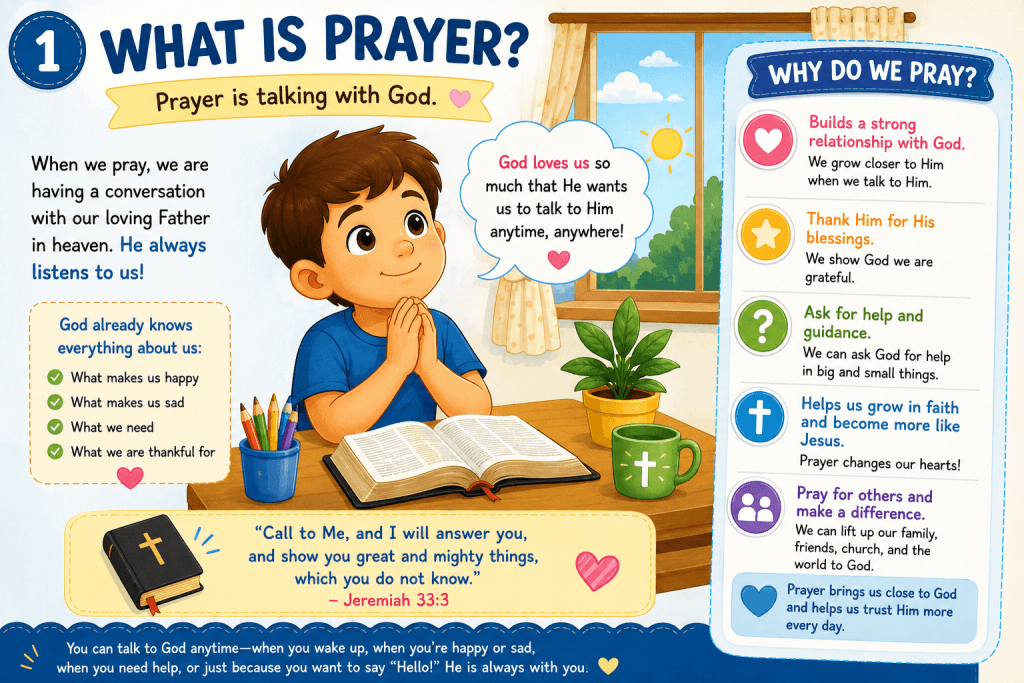
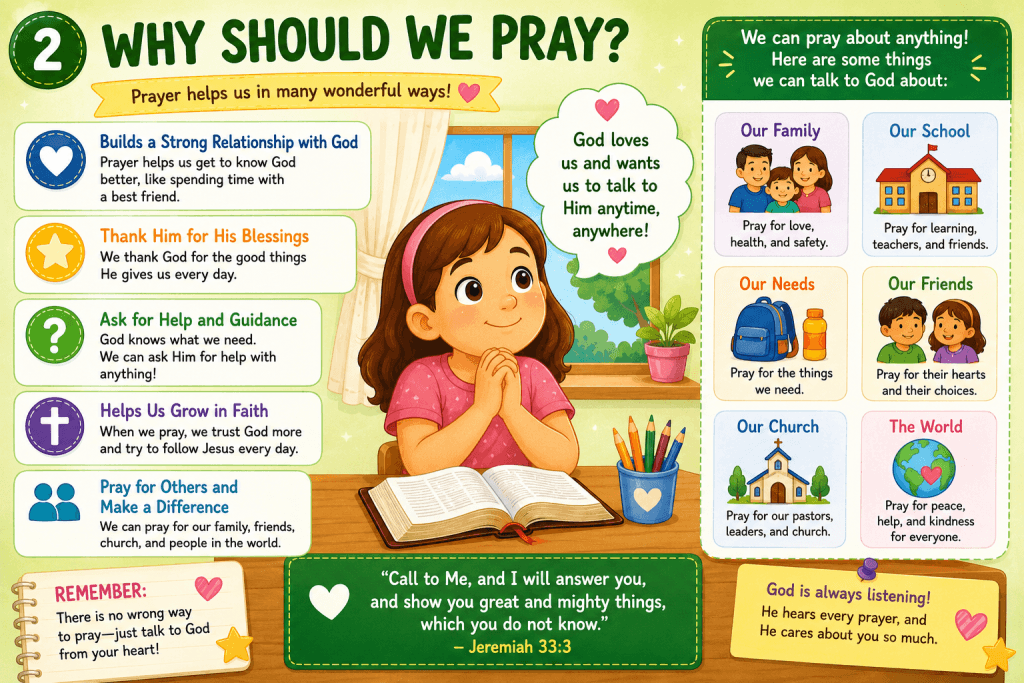

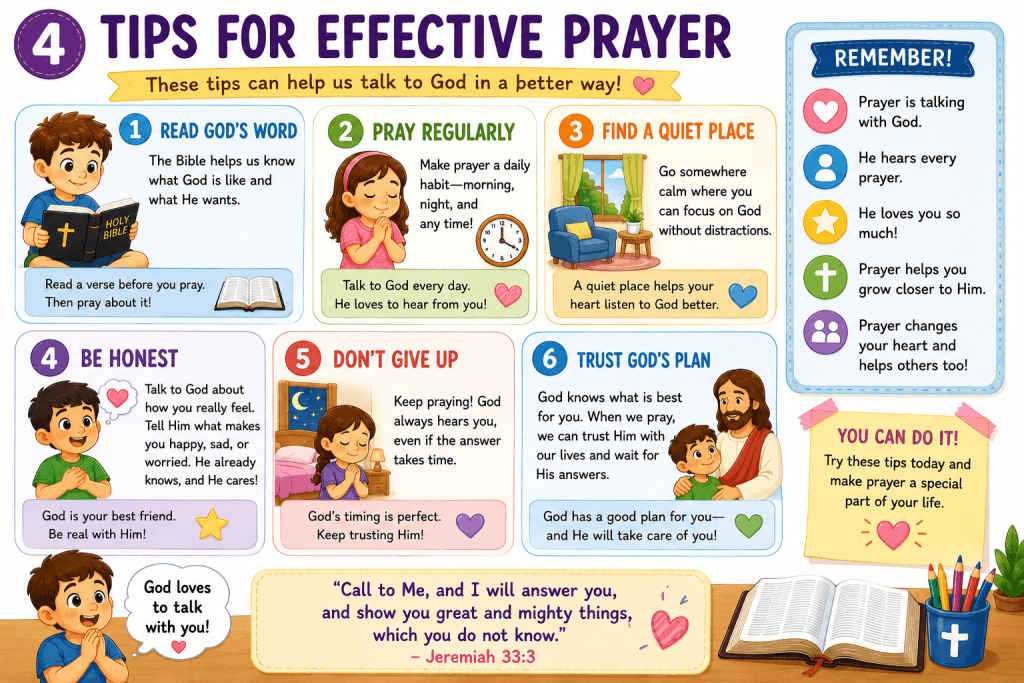

Children Coloring Pages
These coloring pages are provided as printable activities for children.


Ready to Finish?
Mark this lesson complete to update your My Harvest progress.