The Importance of Prayer

Lesson Information
This lesson helps learners understand The Importance of Prayer through the truth of Scripture. Using Philippians 4:6–7 as the foundation, the lesson connects biblical meaning with everyday discipleship so adults, youth, and children can understand what God says, why it matters, and how to live it out through Prayer Life, God's Presence, Faithfulness, Dependence, and Communication.
Content

Scripture Reading
- These notes are personal and are not shared.
- These notes are personal and are not shared.
- These notes are personal and are not shared.
- These notes are personal and are not shared.
- These notes are personal and are not shared.
- These notes are personal and are not shared.
Adult Passage 1
6 Be anxious for nothing, but in everything by prayer and supplication with thanksgiving let your requests be made known to God.
7 And the peace of God, which surpasses all comprehension, will guard your hearts and your minds in Christ Jesus.
Adult Explanation
Paul wrote the letter to the Philippians while facing imprisonment and uncertainty, yet his message is filled with joy, confidence, and trust in God. Near the end of the letter, Paul addresses one of the most common struggles believers face: anxiety. Instead of allowing fear and worry to control the heart, Paul points Christians toward prayer. These verses teach that God does not intend for His people to carry life's burdens alone. Prayer becomes the means by which believers bring every concern before God and experience His peace. As the foundational passage for this lesson, Philippians 4:6–7 reveals that prayer is not merely a spiritual discipline but a daily expression of dependence upon God.
Focus on the Scripture
The central command is to replace anxiety with prayer. Believers are instructed to bring every concern to God through prayer, supplication, and thanksgiving. The promise is that God's peace will guard their hearts and minds in Christ Jesus. Christians should pay close attention to the connection between prayer and peace because spiritual growth happens when trust in God becomes greater than fear of circumstances.
Adult Exegesis
Keyword Study
Prayer — Greek: proseuchē (pro-soo-KHAY). This word refers to worshipful communication directed toward God. It emphasizes dependence, reverence, and fellowship with the Lord rather than simply making requests.
Peace — Greek: eirēnē (i-ray-NAY). This term describes wholeness, tranquility, and inner security that come from God. It points to a peace that remains even when circumstances are difficult.
Paul presents a direct contrast between anxiety and prayer. Anxiety focuses attention on problems and human limitations, while prayer directs attention toward God's power, faithfulness, and care. Rather than suppressing concerns, believers are encouraged to bring them honestly before the Lord. This demonstrates trust in God's character and His willingness to hear His people.
The inclusion of thanksgiving is significant. Gratitude reminds believers of God's past faithfulness and encourages confidence in His future provision. Prayer that includes thanksgiving is not dependent on favorable circumstances but on the unchanging goodness of God. This attitude transforms how Christians view trials and challenges.
The promise of God's peace goes beyond human understanding. Paul teaches that God's peace guards the hearts and minds of believers through Christ. The image is that of divine protection over the inner life. Through prayer, believers experience God's presence and find strength to remain faithful even during difficult seasons.
Adult Application
* Bring specific worries to God in prayer each day rather than carrying them alone.
* Keep a prayer journal that includes both requests and reasons for thanksgiving.
* When anxiety begins to rise, stop and pray before reacting emotionally.
* Develop a consistent Prayer Life by setting aside daily time with God.
* Trust God's Presence and peace even when circumstances remain unchanged.
Adult Passage 2
9 “Pray, then, in this way: ‘Our Father who is in heaven, Hallowed be Your name.
10 Your kingdom come. Your will be done, On earth as it is in heaven.
11 Give us this day our daily bread.
12 And forgive us our debts, as we also have forgiven our debtors.
13 And do not lead us into temptation, but deliver us from evil. [For Yours is the kingdom and the power and the glory forever. Amen.’]
Adult Explanation
Matthew 6:9–13 is part of Jesus' Sermon on the Mount. Before teaching this model prayer, Jesus warns against praying merely to impress others or repeating empty words. He then provides a pattern that teaches His followers how to approach God. Commonly called the Lord's Prayer, this passage reveals the priorities that should shape a believer's prayer life. It teaches worship, dependence, submission to God's will, forgiveness, and spiritual protection. Rather than giving a rigid formula, Jesus provides a framework for meaningful communication with God.
Focus on the Scripture
The main focus is learning to pray according to God's priorities. Jesus teaches believers to begin with God's holiness and kingdom before moving to personal needs. Christians should pay close attention to the balance between worship, dependence, obedience, and trust because prayer is designed to deepen a relationship with God rather than simply obtain answers.
Adult Exegesis
Keyword Study
Father — Greek: patēr (pa-TAIR). This word emphasizes a personal relationship with God. Through Christ, believers are invited to approach God as loving children approach a caring father.
Kingdom — Greek: basileia (bah-see-LAY-ah). This term refers to God's rule, authority, and reign. Praying for God's kingdom reflects a desire for His will and purposes to be accomplished.
Jesus begins by directing attention to God's name and glory. Prayer starts with worship because understanding who God is shapes how believers bring requests before Him. Reverence and praise help align the heart with God's character and purposes.
The requests for daily bread teach dependence. Every need, whether physical, emotional, or spiritual, ultimately comes under God's care. Prayer reminds believers that self-sufficiency is an illusion and that God remains the true provider of every good gift.
The prayer concludes with forgiveness and spiritual protection. Those who receive God's grace are called to extend grace to others. Likewise, believers recognize their need for God's help in resisting temptation and remaining faithful. The entire prayer provides a balanced model for Christian discipleship and communication with God.
Adult Application
* Begin prayer times with praise and worship before presenting requests.
* Ask God daily to align your plans and decisions with His will.
* Depend on God for both practical needs and spiritual growth.
* Practice forgiveness toward others as part of your prayer life.
* Seek God's help when facing temptation, challenges, and difficult choices.
Adult Passage 3
16 Rejoice always;
17 pray without ceasing;
18 in everything give thanks; for this is God’s will for you in Christ Jesus.
Adult Explanation
Paul wrote to the Thessalonian believers to encourage them as they lived faithfully while awaiting Christ's return. Near the conclusion of the letter, he gives a series of short but powerful instructions that summarize key habits of Christian living. Among these commands are rejoicing always, praying without ceasing, and giving thanks in every circumstance. These verses demonstrate that prayer is not meant to be an occasional activity but an ongoing lifestyle. Through continual prayer, believers remain connected to God's presence and develop greater dependence upon Him.
Focus on the Scripture
The main truth is that prayer should become a constant part of daily life. Christians should notice how prayer, joy, and thanksgiving are connected. A growing believer learns to communicate with God regularly, trust Him in every season, and maintain an attitude of gratitude regardless of circumstances.
Adult Exegesis
Keyword Study
Pray — Greek: proseuchomai (pro-syoo-KHO-my). This verb means to communicate with God through worship, requests, thanksgiving, and devotion. The ongoing tense emphasizes continual action.
Give Thanks — Greek: eucharisteō (yoo-khar-is-TEH-o). This word means to express gratitude and appreciation. It points believers toward recognizing God's goodness and faithfulness in every circumstance.
The command to pray without ceasing does not mean believers must verbally pray every moment of every day. Instead, it describes a heart that remains continually aware of God's presence and regularly communicates with Him throughout daily life. Prayer becomes a constant relationship rather than a scheduled event alone.
Paul links prayer with joy and thanksgiving because these habits strengthen one another. Prayer builds trust in God, trust produces joy, and gratitude reminds believers of God's faithfulness. Together they create a Christ-centered perspective that helps believers endure challenges with hope.
Paul concludes by describing these practices as God's will for believers in Christ Jesus. While Christians often seek God's will regarding major decisions, Paul reminds them that God's will also includes faithful daily habits. Continual prayer, thanksgiving, and dependence upon God are marks of spiritual maturity and growth.
Adult Application
* Speak with God throughout the day instead of limiting prayer to specific times.
* Develop the habit of thanking God for blessings both large and small.
* Turn daily decisions, concerns, and opportunities into moments of prayer.
* Use reminders or routines to strengthen a consistent Prayer Life.
* Demonstrate Faithfulness by continuing to pray even during difficult seasons.
Adult Passage 4
3 ‘Call to Me and I will answer you, and I will tell you great and mighty things, which you do not know.’
Adult Explanation
Jeremiah 33:3 was spoken during a time of deep national crisis. Jeremiah was confined, Jerusalem was under judgment, and the people of Judah were facing the painful results of long-term rebellion against God. Yet in the middle of that darkness, God invited Jeremiah to call upon Him. This passage shows that prayer is not only for peaceful seasons. Prayer is especially important when life feels uncertain, heavy, confusing, or beyond human control. God presents Himself as the One who hears, answers, and reveals what His people could never understand apart from Him.
Focus on the Scripture
The central truth is that God invites His people to call on Him. This passage teaches dependence because prayer begins with the humble admission that God knows what we do not know and sees what we cannot see. Believers should pay close attention to God’s willingness to hear and answer. Prayer is not empty religious speech; it is communication with the living God who is faithful, present, and wise.
Adult Exegesis
Keyword Study
Call — Hebrew: qara (kah-RAH). This word means to call out, cry aloud, summon, or appeal. In this passage, it points to an intentional turning toward God in faith, need, and dependence.
Answer — Hebrew: anah (ah-NAH). This word means to respond, reply, or give an answer. It highlights that God is not distant or silent toward His people but is able to respond according to His wisdom and purpose.
Jeremiah 33:3 teaches that prayer begins with God’s gracious invitation. The Lord does not tell Jeremiah to look within himself for strength or search the circumstances for hope. Instead, God commands him to call upon Him. This reminds believers that prayer is rooted in God’s character, not in the strength of the person praying.
The promise that God will answer must be understood in the context of God’s covenant faithfulness and wisdom. God does not promise to fulfill every personal preference, but He does promise to reveal what is true, necessary, and beyond human understanding. Prayer draws believers into deeper trust as they learn to seek God’s will rather than merely their own desired outcome.
This passage also points to the larger biblical pattern of restoration. Even when God’s people are weak, confused, or facing consequences, He calls them back into relationship with Himself. Prayer becomes a pathway of renewed dependence, spiritual clarity, and confidence in God’s presence.
Adult Application
* Call on God during confusing or painful seasons instead of relying only on personal control or understanding.
* Ask God for wisdom, direction, and spiritual clarity, not only relief from difficulty.
* Practice Dependence by bringing family, work, church, and personal decisions before God first.
* Trust that God hears and answers according to His faithfulness, even when His answer is not immediate.
* Let prayer remind you that God’s Presence is greater than what you can see or understand.
Adult Passage 5
16 Therefore, confess your sins to one another, and pray for one another so that you may be healed. The effective prayer of a righteous man can accomplish much.
Adult Explanation
James writes with a strong emphasis on practical faith. Throughout his letter, he shows that genuine faith is not merely spoken but lived through humility, obedience, endurance, and love for others. In James 5, the church is instructed to pray in suffering, praise in joy, seek spiritual help when weak, confess sin, and pray for one another. This passage shows that prayer is both personal and communal. God uses honest confession, spiritual accountability, and faithful prayer to bring healing, restoration, and strength within the body of Christ.
Focus on the Scripture
The central focus is the powerful role of prayer within Christian community. Believers should notice the connection between confession, prayer, righteousness, and healing. This passage matters because spiritual growth is not meant to happen in isolation. Prayer strengthens relationships, brings sin into the light, encourages humility, and helps the church care for one another with grace and truth.
Adult Exegesis
Keyword Study
Confess — Greek: exomologeō (ex-o-mo-lo-GEH-o). This word means to openly acknowledge, agree, or admit. In this context, it points to honest admission of sin and need within appropriate spiritual relationships.
Effective — Greek: energeō (en-er-GEH-o). This word means to work, be active, or produce results. It emphasizes that prayer is not powerless or meaningless; God works through faithful prayer according to His will.
James connects prayer with spiritual honesty. Confession is not meant to create shame, gossip, or public embarrassment. Instead, it brings sin into the light so repentance, healing, and restoration can take place. A spiritually healthy church is a praying church where believers are humble enough to ask for help and mature enough to respond with grace.
The reference to the prayer of a righteous person does not teach that prayer is powerful because a person is sinless. Rather, it points to a life oriented toward God through faith, repentance, and obedience. Prayer is not a technique to manipulate God. It flows from a heart that desires fellowship with Him and alignment with His will.
This passage also fits the larger biblical picture of God’s people living as a covenant community. Believers are called to bear burdens, restore the struggling, and encourage one another toward holiness. Prayer is one of the ways the church demonstrates God’s love and faithfulness to one another.
Adult Application
* Build trustworthy spiritual relationships where confession, prayer, and accountability can happen with wisdom and grace.
* Pray seriously for others in the church, believing that God works through faithful prayer.
* Bring sin and struggle into the light with appropriate mature believers instead of hiding in isolation.
* Let Communication with God shape communication with others through humility, honesty, and compassion.
* Make prayer a regular part of caring for family, church members, and those who are spiritually weak or hurting.
Adult Passage 6
Adult Explanation
Luke 18:1 introduces Jesus’ parable of the persistent widow. Luke clearly states the purpose before the parable begins: Jesus wanted His disciples to pray and not lose heart. The disciples would face waiting, opposition, injustice, discouragement, and unanswered questions. Jesus knew that delayed answers could tempt believers to give up. This passage connects prayer with perseverance and faithfulness. It teaches that prayer is not only something believers do when they feel strong; it is one of the ways God sustains His people when they feel weak.
Focus on the Scripture
The main command is to keep praying and not give up. Believers should pay close attention to the connection between persistent prayer and spiritual endurance. This passage matters because a mature Prayer Life is not built only in easy seasons. It is formed through continued dependence on God when the answers seem delayed, the burden remains heavy, or the heart feels discouraged.
Adult Exegesis
Keyword Study
Pray — Greek: proseuchomai (pro-syoo-KHO-my). This word means to communicate with God through worship, request, thanksgiving, and dependence. It describes prayer as ongoing relationship with God.
Lose Heart — Greek: enkakeō (en-kah-KEH-o). This word means to become weary, discouraged, fainthearted, or give up. Jesus uses this idea to warn against the spiritual danger of discouragement that causes believers to stop praying.
Luke makes the point of Jesus’ teaching unmistakable. Disciples must continue in prayer and resist the temptation to quit. This is important because discouragement can quietly weaken faith. When circumstances do not change quickly, believers may begin to wonder whether prayer matters. Jesus confronts that struggle and calls His followers to persevere.
Persistent prayer does not mean trying to pressure God or wear Him down. The larger parable contrasts an unjust judge with the righteous character of God. God is not reluctant, uncaring, or unjust. He is faithful and good. The call to persistent prayer is a call to keep trusting God’s character even when His timing is not immediate.
This passage also points toward the faith required as believers await Christ’s return and God’s final justice. Christians live between promise and fulfillment. Prayer keeps the heart anchored in God’s presence while waiting. It trains believers to remain faithful, dependent, and hopeful.
Adult Application
* Keep praying for long-term burdens while trusting God’s timing and faithfulness.
* When discouragement grows, choose prayer before withdrawal, bitterness, or giving up.
* Build regular rhythms of persistent prayer for family, church needs, salvation, healing, and spiritual growth.
* Encourage weary believers by praying with them and reminding them of God’s Presence.
* Let delayed answers deepen Dependence on God rather than weaken confidence in Him.
Adult Summary
The Importance of Prayer is rooted in the truth that God invites His people into faithful, ongoing communication with Him. Philippians 4:6–7 teaches that prayer is the believer’s response to anxiety and that God’s peace guards the heart and mind through Christ. Matthew 6:9–13 shows that prayer begins with worship, seeks God’s kingdom, depends on Him for daily needs, includes forgiveness, and asks for spiritual protection. 1 Thessalonians 5:16–18 teaches that prayer is not occasional but continual, woven into a life of joy and thanksgiving.Jeremiah 33:3 reminds believers that God invites His people to call upon Him and trust Him for wisdom beyond their own understanding. James 5:16 shows that prayer belongs within the life of the church, where confession, accountability, healing, and restoration are practiced with humility and faith. Luke 18:1 teaches believers to persist in prayer and not lose heart when answers seem delayed.Together, these passages show that prayer is essential for growing in Christ. Prayer strengthens Dependence, deepens awareness of God’s Presence, forms Faithfulness, and teaches believers to communicate with God in every season. The next faithful step is to move prayer from an occasional response to a daily spiritual habit: bringing worries to God, worshiping Him first, thanking Him often, confessing honestly, praying with others, and continuing faithfully even when waiting is hard.Adult Questions
- What repeated truths about prayer do you see across this lesson, especially regarding anxiety, worship, thanksgiving, dependence, confession, persistence, and peace?Your personal thoughts are private and are not shared.
- How does the full lesson show that prayer is more than asking God for help, but also ongoing communication, surrender, trust, and fellowship with Him?Your personal thoughts are private and are not shared.
- Where do you most need to grow in prayer right now: bringing worries to God, praying consistently, giving thanks, confessing honestly, depending on Him, or continuing when discouraged?Your personal thoughts are private and are not shared.
- What practical step can you take this week to strengthen your Prayer Life and trust God more deeply in everyday responsibilities?Your personal thoughts are private and are not shared.
- How can this group support one another through prayer, testimony, accountability, encouragement, and faithful care?Your personal thoughts are private and are not shared.
Adult Prayer

Scripture Reading
- These notes are personal and are not shared.
- These notes are personal and are not shared.
- These notes are personal and are not shared.
- These notes are personal and are not shared.
- These notes are personal and are not shared.
- These notes are personal and are not shared.
Youth Explanation
Paul wrote Philippians while he was in a difficult situation, but he still taught believers to trust God, rejoice in Christ, and pray instead of being controlled by worry. Philippians 4:6–7 shows that prayer is one of the ways Christians bring fear, stress, pressure, and uncertainty to God. This passage does not say life will always be easy, but it does teach that God gives peace to those who come to Him with honest prayer and thanksgiving.
Focus on the Scripture
The main truth is that God wants His people to bring everything to Him in prayer. Teenagers should pay attention to the connection between anxiety, prayer, thanksgiving, and peace. When school, friendships, family problems, decisions, or pressure feel overwhelming, God invites believers to talk to Him instead of carrying everything alone.
Youth Application
* When you feel stressed or anxious, pause and tell God specifically what is weighing on your heart.
* Practice thanking God during prayer, even before the situation changes.
* Before reacting to drama, pressure, or conflict, take time to pray and ask God for peace.
* Build a Prayer Life by praying about school, friendships, family, church, and your future.
* Remember that God’s Presence is with you even when your circumstances feel uncertain.
Youth Summary
Prayer is an important part of growing in Christ because it keeps believers connected to God. Philippians 4:6–7 teaches that we can bring anxiety to God and receive His peace. Matthew 6:9–13 shows us how Jesus taught His followers to pray with worship, dependence, forgiveness, and trust. 1 Thessalonians 5:16–18 reminds us to pray continually and give thanks in every season.Jeremiah 33:3 teaches that God invites us to call on Him. James 5:16 shows that prayer also belongs in Christian community, where believers are honest, humble, and supportive. Luke 18:1 reminds us to keep praying and not give up. For teenagers, the next step is to make prayer part of everyday life—at school, at home, with friends, online, at church, and in private—trusting that God hears, cares, and is present.Youth Questions
- What do these passages teach us about what prayer is and why it matters?Your personal thoughts are private and are not shared.
- How is prayer more than just asking God for things we want?Your personal thoughts are private and are not shared.
- What makes prayer hard for you: worry, distraction, discouragement, guilt, or not knowing what to say?Your personal thoughts are private and are not shared.
- What is one way you can make prayer a more regular part of your week?Your personal thoughts are private and are not shared.
- How can this group help one another grow through prayer, encouragement, and accountability?Your personal thoughts are private and are not shared.
Youth Prayer

Scripture Reading
- These notes are personal and are not shared.
- These notes are personal and are not shared.
- These notes are personal and are not shared.
- These notes are personal and are not shared.
- These notes are personal and are not shared.
- These notes are personal and are not shared.
Children Explanation
Paul taught believers that they could talk to God when they felt worried. Sometimes children feel worried about school, friends, family, or something new. God does not want His children to carry worries alone. He wants them to pray, thank Him, and trust Him. God can give peace to our hearts because He is near and He cares.
Focus on the Scripture
The main lesson is that children can bring every worry to God in prayer. This passage helps children remember that prayer is talking to God and trusting Him with what is on their hearts.
Children Application
* Tell God when you feel worried or afraid.
* Thank God for one good thing each day.
* Pray before school, bedtime, or something hard.
* Ask God to help your heart feel peaceful.
* Remember that God is with you.
Children Summary
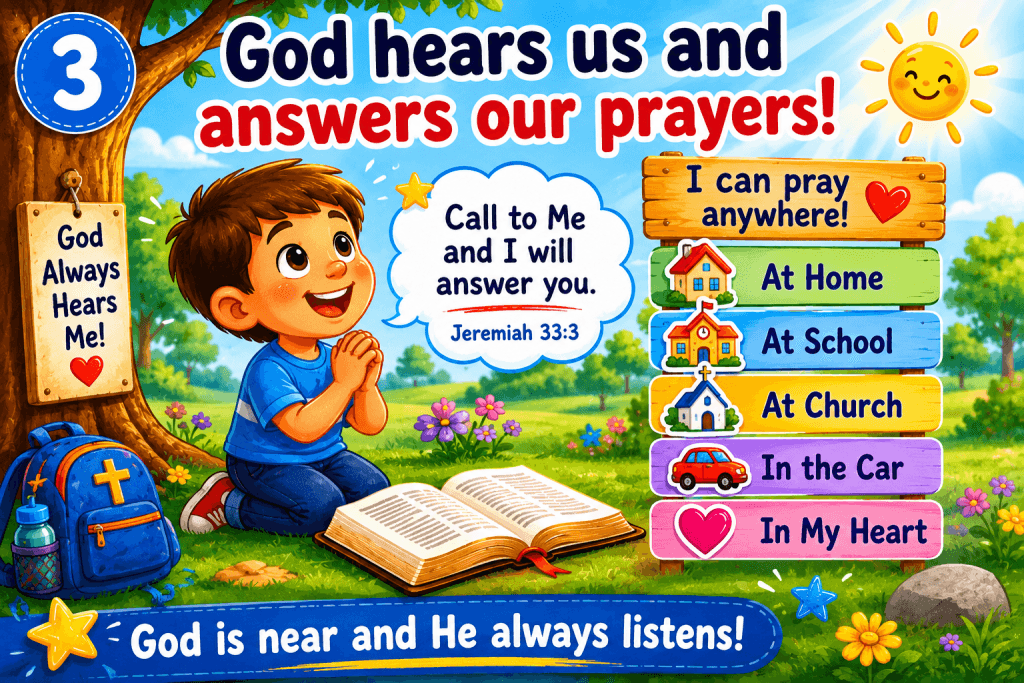
Prayer means talking to God. God wants His children to bring their worries, needs, thanks, and questions to Him. Philippians 4:6–7 teaches that we can pray when we are worried and God can give us peace. Jesus teaches us how to pray, Paul reminds us to pray often, Jeremiah shows us that God hears when we call, James teaches us to pray for one another, and Luke reminds us to keep praying and not give up. Children can pray anywhere and anytime because God is always near.Children Questions
- What did we learn prayer is?Your personal thoughts are private and are not shared.
- Why does God want His children to talk to Him?Your personal thoughts are private and are not shared.
- What is something that makes it hard for you to pray?Your personal thoughts are private and are not shared.
- When can you pray this week at home, school, church, or with your family?Your personal thoughts are private and are not shared.
- Who is someone we can pray for together today?Your personal thoughts are private and are not shared.
Children Prayer
Children Printable Images
These images are provided as printable lesson pages for children.




Children Coloring Pages
These coloring pages are provided as printable activities for children.


Ready to Finish?
Mark this lesson complete to update your My Harvest progress.