Worship as a Lifestyle
Lesson Information
This lesson helps learners understand Worship as a Lifestyle through the truth of Scripture. Using Romans 12:1–2 as the foundation, the lesson connects biblical meaning with everyday discipleship so adults, youth, and children can understand what God says, why it matters, and how to live it out through Worship, Praise, Surrender, Gratitude, and Holiness.
Content

Scripture Reading
- These notes are personal and are not shared.
- These notes are personal and are not shared.
- These notes are personal and are not shared.
- These notes are personal and are not shared.
- These notes are personal and are not shared.
- These notes are personal and are not shared.
Adult Passage 1
1 Therefore I urge you, brethren, by the mercies of God, to present your bodies a living and holy sacrifice, acceptable to God, which is your spiritual service of worship.
2 And do not be conformed to this world, but be transformed by the renewing of your mind, so that you may prove what the will of God is, that which is good and acceptable and perfect.
Adult Explanation
Romans 12 begins the practical application section of Paul’s letter after he has carefully explained God’s mercy, grace, salvation, justification, and faithfulness. Because of all God has done through Christ, Paul urges believers to respond with whole-life worship. Worship is not limited to songs, services, or outward religious moments. It involves offering the entire self to God: body, mind, desires, habits, relationships, work, and decisions. This passage teaches that worship as a lifestyle begins with surrender and continues through transformation.
Focus on the Scripture
The main command is to present our lives to God as an act of worship and to be transformed by the renewing of the mind. Adults should pay close attention to the connection between God’s mercy and our response. We do not worship to earn God’s favor; we worship because God has shown mercy in Christ. True worship includes surrender, holiness, discernment, and daily obedience to the will of God.
Adult Exegesis
Keyword Study
Present — Greek: <em>paristemi</em> (pah-RIS-tay-mee). This word means to offer, place at someone’s disposal, or make available for service. It helps show that Christian worship involves willingly giving ourselves to God.
Transformed — Greek: <em>metamorphoo</em> (meh-tah-mor-FOH-oh). This word means to be changed in form or nature. It describes deep inward change, not merely outward religious behavior.
Paul grounds the call to worship in the mercies of God. The Christian life is not built on self-effort or religious performance but on gratitude for grace. Because God has shown mercy, believers respond by offering themselves fully to Him. This makes worship personal and practical. The believer’s body, choices, speech, time, work, family life, and service all become part of worship.
The contrast between being conformed to the world and being transformed by the renewing of the mind is central to this passage. The world pressures believers to think, desire, and live according to patterns that resist God. Scripture, prayer, and the Spirit’s work renew the mind so believers can discern and desire what pleases God. Worship as a lifestyle requires a changed mind, not just changed behavior.
This passage also connects worship with holiness. A living sacrifice is not dead ritual but active surrender. God calls His people to live in ways that are holy and pleasing to Him. As the believer’s mind is renewed, obedience becomes clearer and discernment grows stronger. Worship becomes the daily practice of saying yes to God in every area of life.
Adult Application
* Begin each day by intentionally surrendering your body, mind, schedule, and decisions to God.
* Identify one worldly pattern shaping your thinking and replace it with Scripture and prayer.
* Treat ordinary responsibilities at home, work, and church as opportunities to worship God.
* Practice gratitude by remembering God’s mercy before asking Him for direction or help.
* Make holiness practical by choosing obedience in speech, entertainment, relationships, and private habits.
---
Adult Passage 2
1 O come, let us sing for joy to the Lord, Let us shout joyfully to the rock of our salvation.
2 Let us come before His presence with thanksgiving, Let us shout joyfully to Him with psalms.
3 For the Lord is a great God And a great King above all gods,
4 In whose hand are the depths of the earth, The peaks of the mountains are His also.
5 The sea is His, for it was He who made it, And His hands formed the dry land.
6 Come, let us worship and bow down, Let us kneel before the Lord our Maker.
7 For He is our God, And we are the people of His pasture and the sheep of His hand. Today, if you would hear His voice,
Adult Explanation
Psalm 95 is a call for God’s people to come before Him with joyful praise, thanksgiving, reverence, and humble worship. The psalm moves from loud celebration to bowed surrender, showing that biblical worship includes both joy and awe. God is praised as Creator, King, Shepherd, and the One who cares for His people. This passage reminds believers that worship is not merely an emotional experience or a church activity. It is the rightful response of the whole heart to who God is and what He has done.
Focus on the Scripture
The main command is to worship the Lord with joyful praise and humble reverence. Adults should pay attention to the movement from singing and thanksgiving to bowing and kneeling. True worship includes gladness, gratitude, humility, and submission. Worship as a lifestyle means remembering God’s greatness and responding with praise, trust, and surrendered obedience.
Adult Exegesis
Keyword Study
Sing — Hebrew: <em>ranan</em> (rah-NAN). This word can mean to shout joyfully, cry out, or sing aloud. It emphasizes heartfelt praise that responds openly to God’s greatness.
Worship — Hebrew: <em>shachah</em> (shah-KHAH). This word means to bow down, prostrate oneself, or show reverent submission. It shows that worship is not only joyful expression but humble surrender before God.
Psalm 95 begins with invitation. The people of God are called to come, sing, shout joyfully, and give thanks. This teaches that praise is not optional decoration in the life of faith. It is a fitting response to the Lord’s greatness. God is worthy of worship because He is Creator and King over all things.
The psalm then deepens from celebration to reverence. The worshiper is called not only to rejoice but also to bow down. This matters because worship can become shallow if it is only about emotion, music, or personal preference. Biblical worship remembers that God is holy, majestic, and worthy of submission. Joy and reverence belong together.
The image of God as Shepherd brings worship close to daily life. God is not only high and exalted; He also cares for His people. Worship as a lifestyle grows when believers remember they belong to the Lord. Gratitude, trust, and obedience flow from knowing that the great King is also the Shepherd who leads and sustains His people.
Adult Application
* Make praise part of daily life by thanking God aloud for His character and care.
* Approach corporate worship with both joy and reverence, not merely preference or routine.
* Let gratitude shape your attitude at home, work, and church, especially during difficulty.
* Practice humility by bowing your heart before God’s authority in decisions and relationships.
* Remember that you belong to the Shepherd, and respond with trust instead of anxiety or self-reliance.
---
Adult Passage 3
23 But an hour is coming, and now is, when the true worshipers will worship the Father in spirit and truth; for such people the Father seeks to be His worshipers.
24 God is spirit, and those who worship Him must worship in spirit and truth.”
Adult Explanation
In John 4, Jesus speaks with the Samaritan woman at the well, crossing cultural, religious, and personal barriers to reveal truth and grace. Their conversation turns to worship, especially the long-standing debate between Jews and Samaritans about the proper place of worship. Jesus redirects the focus from location to the nature of true worship. He teaches that the Father seeks worshipers who worship in spirit and truth. This passage is essential for understanding worship as a lifestyle because it shows that true worship is not confined to a place but flows from a heart transformed by God and grounded in His truth.
Focus on the Scripture
The main truth is that God seeks true worshipers who worship Him in spirit and truth. Adults should pay close attention to the fact that Jesus does not reduce worship to location, tradition, emotion, or external ritual. True worship involves the inner person responding sincerely to God according to the truth He has revealed. Worship as a lifestyle must be heartfelt, Christ-centered, Scripture-shaped, and pleasing to the Father.
Adult Exegesis
Keyword Study
Worship — Greek: <em>proskyneo</em> (pros-koo-NEH-oh). This word means to bow down, show reverence, or give honor. It emphasizes humble devotion and reverent response to God.
Truth — Greek: <em>aletheia</em> (ah-LAY-thay-ah). This word means truth, reality, or what is genuine. In John’s Gospel, truth is closely connected to God’s revelation in Christ.
Jesus shifts the discussion from religious geography to spiritual reality. The Samaritan woman was thinking in terms of where worship should happen, but Jesus teaches that the coming reality of worship is centered in the Father’s revelation through the Son. True worship is not made acceptable by location alone. It is made acceptable by coming to God according to His truth.
Worship in spirit involves more than outward form. It means worship that is sincere, inward, and responsive to God. At the same time, worship in truth means worship must be grounded in who God is and what He has revealed. Emotion without truth can become shallow, and truth without heartfelt surrender can become cold. Jesus holds both together.
This passage also reveals the Father’s desire. God is not merely accepting worshipers reluctantly; He seeks true worshipers. This is a gracious invitation. Through Christ, people from every background are called into true worship. Worship as a lifestyle grows when believers bring their whole hearts before God and allow His truth to shape their praise, surrender, holiness, and obedience.
Adult Application
* Examine whether your worship is only outward routine or a sincere response of the heart to God.
* Let Scripture shape your worship so your praise is grounded in truth, not just emotion.
* Remember that worship is not limited to a church building; honor God in ordinary daily choices.
* Bring honesty before God in prayer, allowing Him to align your heart with His truth.
* Worship Christ through obedience, gratitude, service, and surrender in every area of life.
Adult Passage 4
16 Let the word of Christ richly dwell within you, with all wisdom teaching and admonishing one another with psalms and hymns and spiritual songs, singing with thankfulness in your hearts to God.
17 Whatever you do in word or deed, do all in the name of the Lord Jesus, giving thanks through Him to God the Father.
Adult Explanation
Colossians 3 describes what life looks like for people who have been raised with Christ. Paul calls believers to put off the old life of sin and put on the new life shaped by compassion, humility, forgiveness, love, peace, and gratitude. In this passage, worship becomes both gathered and everyday. The word of Christ is to dwell richly among believers, shaping their teaching, singing, gratitude, speech, and actions. Worship as a lifestyle means that Christ’s truth fills the heart so fully that it affects what believers say, how they encourage one another, how they sing, and how they live in His name.
Focus on the Scripture
The main command is to let the word of Christ richly dwell within the community of believers and to do everything in the name of the Lord Jesus. Adults should pay close attention to the connection between Scripture, worship, gratitude, and daily obedience. True worship is not separated from the Word of God. When Christ’s Word fills the heart, worship becomes visible in praise, relationships, service, speech, and ordinary responsibilities.
Adult Exegesis
Keyword Study
Dwell — Greek: <em>enoikeo</em> (en-oy-KEH-oh). This word means to live in, inhabit, or make a home within. It shows that the word of Christ is not meant to visit the believer occasionally but to take up residence in the life of the church and the heart of the disciple.
Thankfulness — Greek: <em>charis</em> (KHAH-rees). This word often means grace, favor, or thanks. In this passage, it points to gratitude that flows from receiving God’s grace in Christ.
Paul teaches that worship is Word-centered. The “word of Christ” includes the message about Christ and the teaching that comes from Him. Worship becomes spiritually healthy when it is shaped by the truth of who Jesus is, what He has done, and how He calls His people to live. Singing, teaching, and encouragement should not be empty emotion but truth-filled praise.
The passage also shows that worship is shared within the body of Christ. Believers teach and admonish one another through wisdom, psalms, hymns, and spiritual songs. Worship is not only an individual experience; it builds up the church. Through Scripture-shaped praise, God’s people remind one another of truth, call one another toward obedience, and cultivate gratitude.
Paul expands worship beyond singing by saying that whatever believers do in word or deed should be done in the name of the Lord Jesus. This connects directly to Romans 12:1–2. Worship includes surrendered living. Every conversation, task, responsibility, act of service, and relationship becomes an opportunity to honor Christ with thanksgiving to God.
Adult Application
* Let Scripture shape your worship by reading and reflecting on God’s Word before singing, serving, or gathering with the church.
* Use your words to encourage, teach, and gently correct others with biblical wisdom and humility.
* Practice gratitude by thanking God in ordinary tasks, family responsibilities, work, and church service.
* Ask whether your speech, decisions, and actions can honestly be done in the name of Jesus.
* Make worship a household rhythm through Scripture reading, prayer, songs of praise, and thankful conversation.
---
Adult Passage 5
15 Through Him then, let us continually offer up a sacrifice of praise to God, that is, the fruit of lips that give thanks to His name.
16 And do not neglect doing good and sharing, for with such sacrifices God is pleased.
Adult Explanation
Hebrews 13 gives practical instructions for faithful Christian living in light of Christ’s finished work. Since Jesus is the final and sufficient sacrifice, believers no longer offer animal sacrifices to approach God. Instead, they offer sacrifices of praise, doing good, and sharing with others. This passage teaches that worship is both verbal and practical. Praise rises from the lips, but worship also shows up in generosity, service, compassion, and love. A lifestyle of worship honors God by confessing His name and reflecting His character toward others.
Focus on the Scripture
The main discipleship focus is that worship includes continual praise and sacrificial love. Adults should pay attention to the fact that God is pleased not only by words of praise but also by doing good and sharing. Worship as a lifestyle means our gratitude to God becomes visible in generosity, service, and care for people around us.
Adult Exegesis
Keyword Study
Sacrifice — Greek: <em>thysia</em> (thoo-SEE-ah). This word refers to an offering or sacrifice given to God. In this passage, it points to worshipful offerings that flow from Christ’s completed sacrifice rather than attempts to earn acceptance.
Praise — Greek: <em>ainesis</em> (EYE-neh-sis). This word means praise, thanksgiving, or confession. It emphasizes worship that openly honors God and acknowledges His name.
Hebrews presents Christian worship in light of the superiority and sufficiency of Christ. Because Jesus has accomplished what the old sacrifices could only point toward, believers respond with praise rather than trying to earn access to God. The sacrifice of praise is offered through Him, meaning worship is made acceptable because of Christ, not because of human performance.
The passage also refuses to separate worship from practical obedience. Doing good and sharing are called sacrifices that please God. This means worship is not confined to what happens in a church service. It includes the way believers use their resources, time, hospitality, compassion, and generosity for the glory of God and the good of others.
This passage fits the larger biblical theme that God desires worship from the whole life. Praise that does not lead to love becomes incomplete. Generosity without devotion can become mere duty. But when praise and service flow from gratitude for Christ, the believer’s life becomes a pleasing offering to God.
Adult Application
* Offer praise to God regularly, even when circumstances are difficult or emotions are heavy.
* Look for one concrete way to do good for someone in your home, church, workplace, or community this week.
* Practice worship through generosity by sharing time, resources, encouragement, or help with someone in need.
* Examine whether your spoken praise is matched by love, service, and obedience in daily life.
* Thank Christ for making your worship acceptable through His finished work, not your own performance.
---
Adult Passage 6
31 Whether, then, you eat or drink or whatever you do, do all to the glory of God.
Adult Explanation
In 1 Corinthians 10, Paul addresses questions about Christian freedom, conscience, idolatry, and how believers should live in a way that honors God and serves others. The Corinthian church needed to learn that freedom in Christ must be guided by love, holiness, and God’s glory. Paul gives a sweeping principle that applies to all of life: even ordinary actions should be done for the glory of God. This passage is essential for worship as a lifestyle because it teaches that no part of life is too small or ordinary to be offered to God.
Focus on the Scripture
The main command is to do everything for the glory of God. Adults should pay close attention to how broad this command is. Worship is not limited to religious activities. Eating, drinking, working, resting, speaking, serving, parenting, decision-making, and relationships can all become acts of worship when they are done with gratitude, holiness, love, and a desire to honor the Lord.
Adult Exegesis
Keyword Study
Glory — Greek: <em>doxa</em> (DOX-ah). This word means glory, honor, splendor, or praise. In this passage, it refers to giving God the honor He deserves through the way one lives.
Do — Greek: <em>poieo</em> (poy-EH-oh). This word means to make, do, practice, or carry out. It emphasizes that God’s glory should shape actual behavior, not merely intentions or religious words.
Paul’s instruction comes in a discussion about everyday decisions and how believers should consider both God’s honor and the good of others. The Christian life is not divided into sacred and ordinary categories. The believer belongs to Christ in every setting, so every choice should be made under the larger purpose of glorifying God.
This passage also teaches that worship involves motive. Two people can perform the same action, but the heart behind it matters. Eating, drinking, working, serving, or speaking can be done selfishly, carelessly, or pridefully. But those same actions can honor God when done with gratitude, love, self-control, and surrender.
The command to do all for God’s glory connects closely with Romans 12:1–2. A living sacrifice is not offered only in special moments. The whole life becomes an offering. Worship as a lifestyle means asking, “Will this honor God?” and allowing that question to shape priorities, habits, relationships, entertainment, service, and decisions.
Adult Application
* Ask before ordinary choices, “Does this honor God and reflect Christ?”
* Treat work, family responsibilities, meals, rest, and service as opportunities to worship the Lord.
* Practice holiness by avoiding choices that may be permissible but do not glorify God or help others.
* Let gratitude shape daily routines so ordinary moments become reminders of God’s goodness.
* Consider how your freedom affects others and choose love, humility, and God’s glory over selfish preference.
---
Adult Summary
This lesson teaches that worship as a lifestyle is the believer’s whole-life response to the mercy, greatness, truth, and glory of God. Romans 12:1–2 provides the foundation by calling believers to present themselves to God as living sacrifices and to be transformed by the renewing of the mind. Worship is not merely outward religious activity; it is surrendered living shaped by gratitude, holiness, and discernment.Psalm 95:1–7 shows that worship includes joyful praise, thanksgiving, reverence, and humble submission before the Lord who is Creator, King, and Shepherd. John 4:23–24 teaches that true worship is not confined to a place or tradition but must be offered in spirit and truth. Colossians 3:16–17 shows that worship is shaped by the word of Christ, expressed in praise, gratitude, teaching, and every word and deed done in Jesus’ name. Hebrews 13:15–16 reminds believers that worship includes continual praise as well as doing good and sharing with others. 1 Corinthians 10:31 gathers the whole lesson into one practical command: everything should be done for the glory of God.The big idea of the Adult lesson is that biblical worship involves the whole person and the whole life. Adults are called to worship through praise, surrender, gratitude, holiness, service, generosity, obedience, and daily dependence on God. The next faithful step is to identify one area of life that has been treated as separate from worship and intentionally offer it to God for His glory.Adult Questions
- What do these passages together teach about worship being more than singing or attending a church service?Your personal thoughts are private and are not shared.
- How does Romans 12:1–2 help us understand the main teaching of the full lesson: that worship involves surrender, transformation, and everyday obedience?Your personal thoughts are private and are not shared.
- What area of your life is hardest to offer to God as worship: your mind, schedule, speech, relationships, work, habits, or resources?Your personal thoughts are private and are not shared.
- What is one practical way you can worship God this week through praise, gratitude, holiness, service, or obedience?Your personal thoughts are private and are not shared.
- How can this group encourage one another to live worshipfully in ordinary moments and pray for areas where surrender is difficult?Your personal thoughts are private and are not shared.
Adult Prayer

Scripture Reading
- These notes are personal and are not shared.
- These notes are personal and are not shared.
- These notes are personal and are not shared.
- These notes are personal and are not shared.
- These notes are personal and are not shared.
- These notes are personal and are not shared.
Youth Explanation
Paul teaches that because God has shown us mercy through Jesus, our response should be to give our whole lives to Him. Worship is not only singing at church. Worship includes what we do with our bodies, minds, choices, habits, relationships, words, and time. Paul also warns believers not to be shaped by the world but to be changed by God through a renewed mind.
Focus on the Scripture
The main truth is that worship means surrendering your whole life to God. Teenagers should pay attention to the difference between being shaped by the world and being transformed by God. Worship as a lifestyle means letting God change the way you think, choose, speak, act, and live every day.
Youth Application
* Start your day by telling God, “My life belongs to You today.”
* Ask God to renew your mind through Scripture instead of letting culture, trends, or pressure shape you.
* Worship God through your choices at school, at home, online, and with friends.
* Surrender one habit, attitude, or relationship area that needs to honor God more.
* Choose holiness when entertainment, popularity, or temptation pulls you away from Jesus.
---
Youth Summary
Worship as a lifestyle means giving your whole life to God because of His mercy. Romans 12:1–2 teaches that true worship is surrender and transformation, not just outward religion. Psalm 95 shows that worship includes joyful praise, thanksgiving, and reverence. John 4 teaches that God wants worship that is sincere and based on truth. Colossians 3 reminds us that Christ’s Word should fill our hearts, songs, words, and actions. Hebrews 13 shows that worship includes praise, doing good, and sharing with others. 1 Corinthians 10:31 teaches that everything can be done for God’s glory.For teenagers, worship is not just what happens during music at church. Worship is how you live at school, at home, online, with friends, in private, and in your daily choices. The next faithful step is to ask God what part of your life needs to be surrendered to Him and then choose to honor Him there this week.Youth Questions
- What do these passages teach us about worship being more than singing at church?Your personal thoughts are private and are not shared.
- How does Romans 12:1–2 help us understand that worship includes surrender, transformation, and everyday choices?Your personal thoughts are private and are not shared.
- What part of your life is hardest to give to God as worship?Your personal thoughts are private and are not shared.
- What is one practical way you can worship God this week at school, at home, online, or with friends?Your personal thoughts are private and are not shared.
- How can our group help each other live for God’s glory in ordinary moments?Your personal thoughts are private and are not shared.
Youth Prayer

Scripture Reading
- These notes are personal and are not shared.
- These notes are personal and are not shared.
- These notes are personal and are not shared.
- These notes are personal and are not shared.
- These notes are personal and are not shared.
- These notes are personal and are not shared.
Children Explanation
Paul teaches that because God has been so kind and merciful to us, we should give our lives to Him. Worship is not only singing songs at church. Worship means loving God with our whole life. We can worship God with our words, choices, bodies, minds, helping hands, kind actions, and obedience. God also helps us think in a new way so we do not just copy what the world says is right.
Focus on the Scripture
The main lesson is that worship means giving our whole life to God. Children should notice that God wants more than songs. He wants our hearts, thoughts, words, and actions. This helps children trust God, obey Him, and live in a way that pleases Him.
Children Application
* Tell God, “My life belongs to You.”
* Use kind words that honor God.
* Obey God at home, school, and church.
* Ask God to help you think His way.
* Choose what is right, even when others do not.
---
Children Summary
Worship is more than singing songs at church. Worship means loving God and honoring Him with our whole life. Romans teaches us to give ourselves to God. Psalm 95 teaches us to praise and thank Him. John 4 teaches us to worship with true hearts. Colossians teaches us to let God’s Word fill our hearts and actions. Hebrews teaches us to praise God, do good, and share. 1 Corinthians teaches us to do everything for God’s glory.The big lesson is that children can worship God every day. We can worship Him when we sing, pray, obey, help, share, tell the truth, forgive, and make choices that please Jesus.Children Questions
- What did we learn worship can include besides singing?Your personal thoughts are private and are not shared.
- Why does God want our whole life, not just our church time?Your personal thoughts are private and are not shared.
- What is one part of your life that you want to give to God?Your personal thoughts are private and are not shared.
- How can you worship God this week at home, school, church, or with friends?Your personal thoughts are private and are not shared.
- How can we pray for each other to praise God, obey Him, and live for His glory?Your personal thoughts are private and are not shared.
Children Prayer
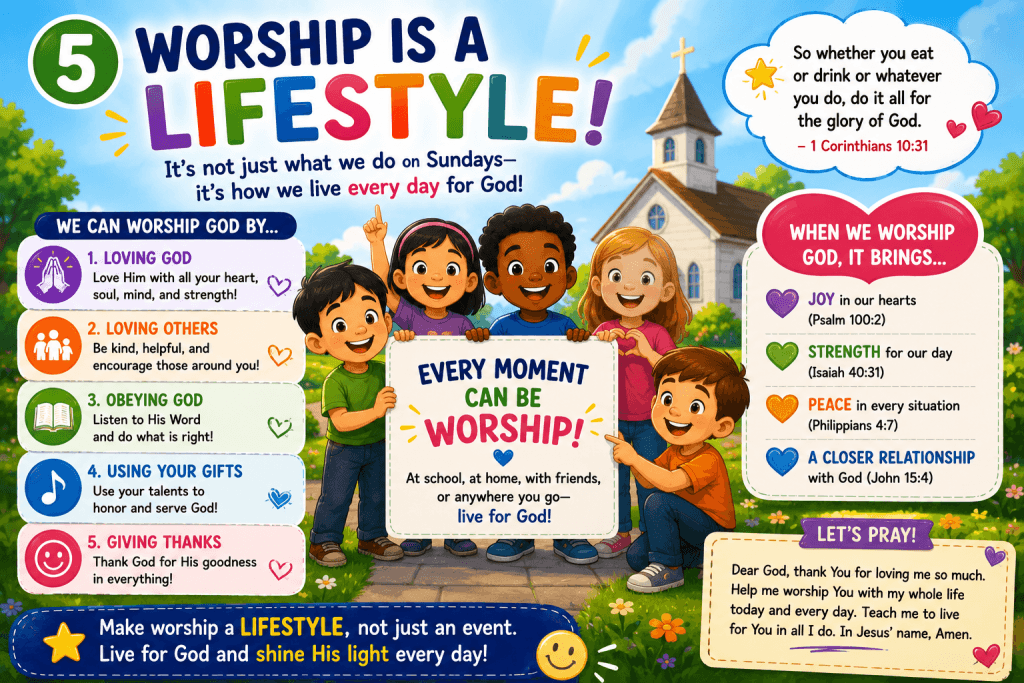
Children Printable Images
These images are provided as printable lesson pages for children.




Children Coloring Pages
These coloring pages are provided as printable activities for children.